
How to Monitor Brand Mentions in ChatGPT (And What to Actually Do With the Data)
By Kristiyan Yankov, Growth Marketer7 min read
Add as a preferred source on Google
A month ago, Above Apex had zero visibility in ChatGPT. No mentions, no citations, nothing. We hadn’t built the off-page presence yet.
We started tracking our brand across a set of prompts using Peec AI. Then we did what we do for clients – got included in the listicles, guides, and editorial pages that ChatGPT actually retrieves from.
Within four weeks: 0.8% visibility, position #3.5 on average, sentiment score of 76, and ChatGPT became our strongest AI model for mentions.
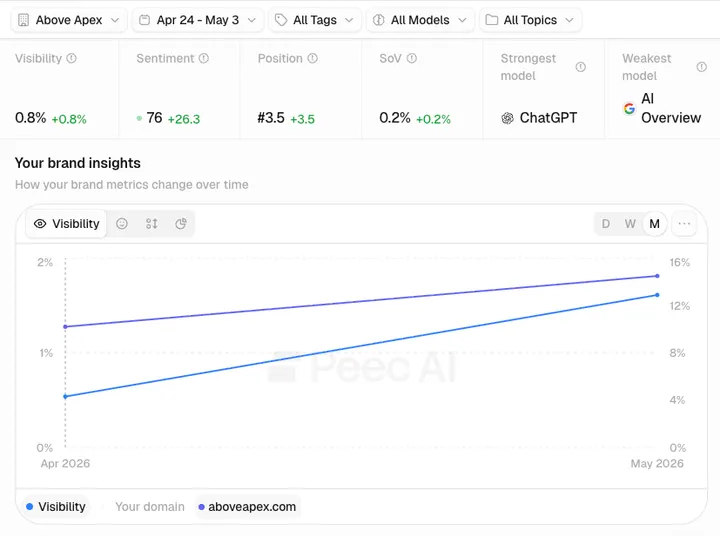
Our own Peec AI dashboard – four weeks after we started building off-page presence.
This isn’t a one-off. We’ve tracked ChatGPT mentions across 60+ B2B SaaS brands over the past 18 months. The pattern is the same every time: the brands that show up in ChatGPT are the brands that are present in the pages ChatGPT pulls from.
Monitoring tells you where you stand. But more importantly, it tells you exactly where to go next.
Why most monitoring advice misses the point
Every guide on this topic says the same thing: “You need to monitor your brand mentions in ChatGPT.” They’re not wrong. But the reason they give – knowing whether you’re being mentioned – is the least interesting part.
The real value of monitoring is finding the opportunity pages.
When you track your brand across 20–100 relevant prompts, you’re not just collecting a yes/no dataset. You’re mapping which pages, articles, listicles, and domains ChatGPT retrieves information from when users ask about your category. That’s the intelligence that actually moves numbers.
Here’s why. ChatGPT doesn’t generate opinions from nothing. It pulls from training data and, with web search enabled (ChatGPT Plus), retrieves live content from the web. The brand mentions you see in its responses are downstream of the content it references. If you’re present in seven out of ten of the most-cited articles for “best marketing analytics software,” your brand will appear in the majority of ChatGPT’s responses to that query.
If you’re in three out of ten, you’ll show up sometimes. If you’re in zero, you don’t exist.
So when you monitor and discover that your competitor is mentioned in a prompt where you’re not, the next step isn’t to shrug. It’s to find the articles ChatGPT is citing in that response, check whether you’re in them, and get included if you’re not.
That’s the action loop. Monitoring is the input. Off-page placement is the output.
What actually counts as a “brand mention” in ChatGPT
Before you start tracking, know what you’re measuring. There are two distinct things:
Brand mentions – your brand name appears directly in ChatGPT’s generated response. Someone asks “What are the best project management tools?” and ChatGPT names you alongside the category leaders. This is what most people mean when they talk about ChatGPT visibility.
Citations – ChatGPT links to a page as a source in its response. Your brand might not be named in the text, but your website or an article featuring you appears in the footnotes. This matters more on ChatGPT Plus (where web search is enabled) and signals that your content or presence is being retrieved even when you’re not explicitly named.
Track both. Mentions tell you about brand awareness in the AI layer. Citations tell you about the content that’s feeding that layer.
One distinction that trips people up: ChatGPT’s free tier and Plus tier pull from different sources. Free relies primarily on training data. Plus adds live web retrieval. A brand can be completely absent from free-tier responses but show up consistently on Plus, or vice versa. Always test both.
How to monitor: the manual method
You can start in ten minutes with no tools and no budget. Here’s the process we use as a baseline for every new client:
Step 1: Build your prompt list. Write 15–20 questions your buyers would actually type into ChatGPT. Mix three types:
- Branded prompts: “What is [your brand]?” / “Tell me about [your brand].”
- Category prompts: “What are the best [your category] tools in 2026?”
- Use-case prompts: “How do I [solve problem your product solves]?”
Don’t write generic prompts. Pull real language from customer support tickets, Reddit discussions, Google’s People Also Ask, and your Search Console query data.
Step 2: Test in a clean environment. Open ChatGPT in a new incognito session. This matters – ChatGPT personalizes responses based on your history, memory, and previous conversations. Incognito strips that away.
Run each prompt twice: once with web search off (to see what training data knows) and once with web search on (to see what it retrieves live). The difference between these two results tells you whether your visibility problem is a training data gap, a web presence gap, or both.
Step 3: Document everything. For each prompt, record:
- Were you mentioned? (Yes/No)
- What position in the response? (First recommendation vs. mentioned fifth)
- Which competitors appeared?
- What sources did ChatGPT cite? (This is the most valuable column)
- Was the description of your brand accurate?
Step 4: Identify the cited pages. This is the step most people skip and the one that generates the most value. For every prompt where you’re not mentioned, look at the sources ChatGPT cited. Those are the pages and domains that are feeding the AI’s understanding of your category. If you’re not in them, that’s your gap – and your opportunity.
The manual method works for establishing a baseline. It doesn’t scale. At around 20–30 prompts, the manual approach becomes unsustainable for ongoing tracking because ChatGPT’s responses are non-deterministic – the same prompt can return meaningfully different answers each time. You need volume and frequency to get reliable signals.
How to monitor: automated tools
Once you’ve established your baseline manually, automated platforms take over the ongoing tracking. We use Peec AI for our client work and have tested most of the alternatives.
- Consistency scoring. You run each prompt multiple times and see how reliably your brand appears – not just whether it appeared once. A brand that shows up in 3 out of 5 runs is in a very different position than one that shows up 5 out of 5.
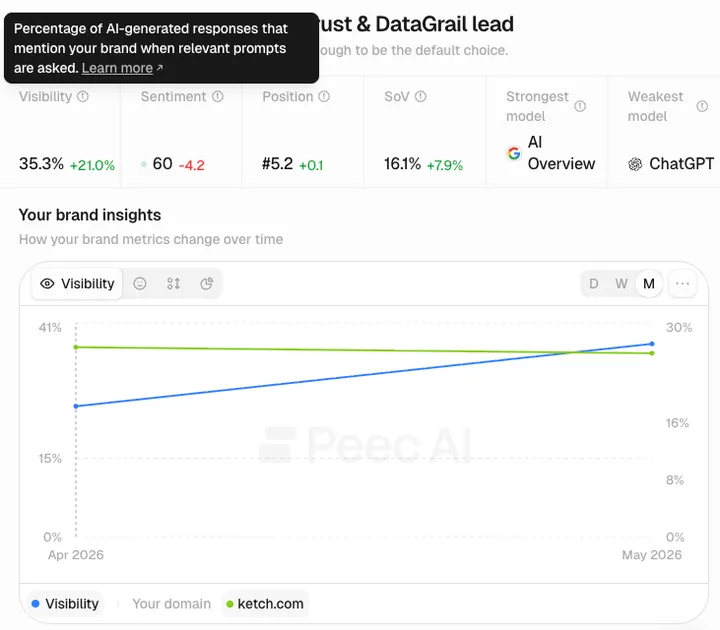
- Multi-model tracking. Track across ChatGPT, Perplexity, Gemini, and Google AI Overviews simultaneously. Your strongest and weakest models may surprise you – for our client Ketch, the strongest model was AI Overviews while ChatGPT was the weakest. Knowing this changes where you focus.
- Trend data over time. The real value shows up over weeks and months. When you launch a new off-page campaign and see mention rates increase three weeks later, you have a direct line between action and outcome.
- Citation tracking. Automated tools surface which domains and pages are being cited across all your tracked prompts. This is the intelligence layer that makes the whole system work – it tells you exactly which pages to target for inclusion.
The leading tools in this space right now:
| Tool | Best for | Pricing |
|---|---|---|
| Peec AI | Comprehensive multi-model tracking with citation analysis | No free tier available |
| Ahrefs Brand Radar | Teams already in the Ahrefs ecosystem | Part of Ahrefs subscription |
| Otterly.AI | Free basic tracking with comparison features | 14-Day Free Trial |
| Profound | Enterprise teams needing cross-platform coverage | Contact sales |
Most platforms generate solid prompt suggestions when you input your brand and category. Use them as a starting point, then add your own prompts based on actual customer language.
What to do with monitoring data
Monitoring is the diagnostic. The treatment is off-page placement.
When your monitoring reveals that you’re not showing up for a specific category of prompts, the fix is almost always the same: get your brand into the pages and articles that ChatGPT is citing in those responses. This is the entity coverage framework we’ve written about in our brand mentions guide – the same work that drives AI Overview citations also drives ChatGPT visibility.
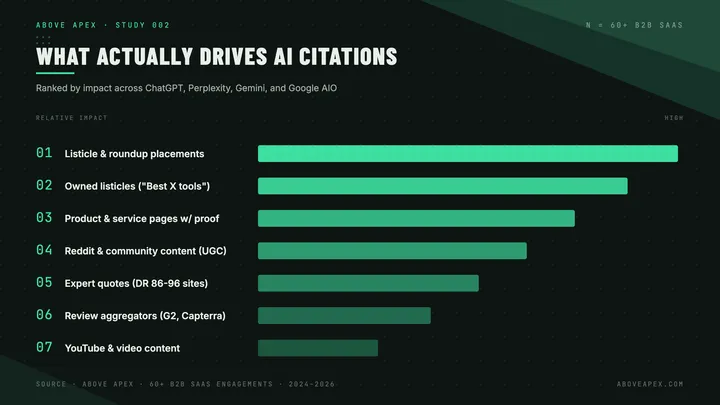
Here’s what that looks like in practice:
Improvado (marketing data platform): After a systematic off-page campaign including expert quote and listicle placements, they added +77 ChatGPT citations and +160 Perplexity citations – alongside +199 Google AI Overview citations and +78,000 monthly organic visits.
Action1 (unified endpoint management): +19 ChatGPT citations and +17 Perplexity citations, plus +617 Google AI Overview citations and +49,700 monthly organic visits.
In both cases, the ChatGPT citations were a byproduct of the off-page presence we were building – not a separate initiative. The monitoring data told us which surfaces mattered most, and the placement work filled those gaps.
The action loop is simple:
- Track your prompts across models.
- Identify which cited pages and domains you’re missing from.
- Get included in those pages through listicle placements, expert quotes, editorial outreach, or content partnerships.
- Re-track and measure the impact.
- Expand your prompt set as you discover new verticals where you could have coverage.
Start simple
Don’t overcomplicate this. Open ChatGPT in incognito. Type the ten questions your buyers ask most. See if you show up. See who does. Look at what ChatGPT cites.
That baseline takes 30 minutes and tells you more about your AI visibility than most teams know about their brand today.
Once you have that, move to automated tracking so you can measure changes over time. And most importantly – use the monitoring data to guide where you build your off-page presence. The brands that win in ChatGPT are the brands that are systematically present in the sources ChatGPT trusts.
Monitoring shows you the map. The off-page work fills it in.