
Using Ahrefs for Unlinked Mentions: How to Find and Turn Them in Backlinks in 2026
By Kristiyan Yankov, Growth Marketer15 min read
Add as a preferred source on Google
Contents
- What are unlinked mentions?
- Why it matters for SEO and AI visibility in 2026
- The honest reality: this is not a scalable strategy
- Real wins from Above Apex client campaigns
- How to find unlinked mentions in Ahrefs
- Method 1: Content Explorer with the “Highlight unlinked” filter
- Method 2: Ahrefs Alerts for ongoing monitoring
- The filters that matter (and why most people get this wrong)
- Contact research: the two-vertical approach
- Vertical 1: Email
- Vertical 2: LinkedIn
- The outreach email template we use
- When NOT to chase unlinked mentions
- What results to expect
- The mistakes we see constantly
- Want this done for you?
In May 2025, we landed a link in The Times – Domain Rating of 91, 1.8 million monthly visitors – for a client called BigChange.
We didn’t write a guest post. We didn’t pitch a story. We didn’t have a PR firm. We sent a short email reclaiming an unlinked mention.
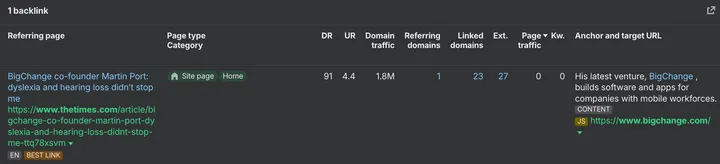
A few weeks later, we landed Action1 in the Daily Record (DR 81, 2.6M monthly visitors) the same way. Then Red Points in Fortune Business Insights (DR 86). Then italki in MyUnidays (DR 77, 2M monthly visitors). Then more wins across Times of Malta, GovExec, NextGov, Pay.com, and Lancashire Telegraph.
Every one of those placements came from the same workflow: find where the brand was already mentioned without a link, send a short, polite email, and close the loop.
This is the single most underrated link building tactic in 2026, and almost nobody runs it properly. Most guides position it as a scalable volume play. It’s not. It’s a low-hanging fruit opportunity that occasionally gives you tier-1 editorial links you couldn’t get any other way.
At Above Apex, we’ve run link building for 60+ companies across every category over the past 24 months and built over 500 brand mentions for SaaS brands in that time. Unlinked mention reclamation has been a consistent source of the highest-authority links in our clients’ backlink profiles – and unlike most link building tactics, it works across every industry without modification. The workflow below is universal. Below is exactly how we run it in Ahrefs – the filters, the outreach template, and the honest realities nobody else writes about.
What are unlinked mentions?
An unlinked mention is when a website mentions your brand, product, or founder by name but doesn’t hyperlink to your site. The Times piece mentioned BigChange throughout the article without a single clickable link back to bigchange.com. That’s an unlinked mention – and because the mention already exists and the publication already finds your brand credible enough to reference, it’s a uniquely warm outreach opportunity.
Compared to cold guest post pitches or digital PR campaigns, you’re not asking an editor to publish new content about you. You’re asking them to add a hyperlink to content they’ve already published. That’s a much smaller ask, and it converts at much higher rates.
Why it matters for SEO and AI visibility in 2026
Two reasons the tactic matters more in 2026 than it did five years ago:
1. The links you can reclaim are impossible to get any other way. Tier-1 publications like The Times, Fortune Business Insights, Daily Record, and Forbes rarely accept cold outreach for guest posts or link insertions. They do, however, occasionally honor polite requests to add a link to content they’ve already written. Reclamation is often the only path to a link from these sites for a company that isn’t a Fortune 500 brand.
2. The AI layer weighs these links heavily. Google AI Overviews, ChatGPT, Perplexity, and Google AI Mode all pull from a pool of trusted editorial sources. A reclaimed link from a DR 85+ publication is one of the strongest signals you can give the AI layer that your brand is a legitimate option to cite. We’ve seen direct correlation between reclaimed tier-1 links and AI Overview citation pickup across multiple client accounts.
A reclaimed unlinked mention is simultaneously doing two jobs: strengthening your organic rankings through a high-authority editorial link, and reinforcing your brand as a trusted entity in the AI systems that are increasingly answering queries on behalf of your buyers.
The honest reality: this is not a scalable strategy
Most articles on this topic position unlinked mention reclamation as a repeatable monthly engine. In our experience running it across dozens of SaaS clients, that’s not accurate.
Here’s what we actually see:
- For small, lesser-known brands, you’ll typically find a handful of qualified unlinked mentions to pursue, maybe 5–10 in total. Once you’ve reclaimed what you can, the well runs dry until you build more general brand mentions through other channels (expert quotes, podcasts, listicles).
- For well-known brands in a competitive category – you might find 50+ qualified unlinked mentions at any given time, with new ones appearing weekly. italki, for example, produced 20+ reclaimable unlinked mentions in a 60-day window because the brand has been around long enough and is well-known enough that journalists and bloggers reference it organically across the web.
The tactic scales with brand size, not with effort. And critically, it works in every industry – unlike most link-building strategies that require category-specific expertise or relationships, unlinked mention reclamation is a universal workflow. We’ve run it for SaaS, ecommerce, fintech, cybersecurity, legal tech, edtech, property tech, data privacy, and trade services. The Ahrefs workflow, the filters, and the outreach template don’t change. Only the scale of the opportunity does, based on how well-known the brand already is.
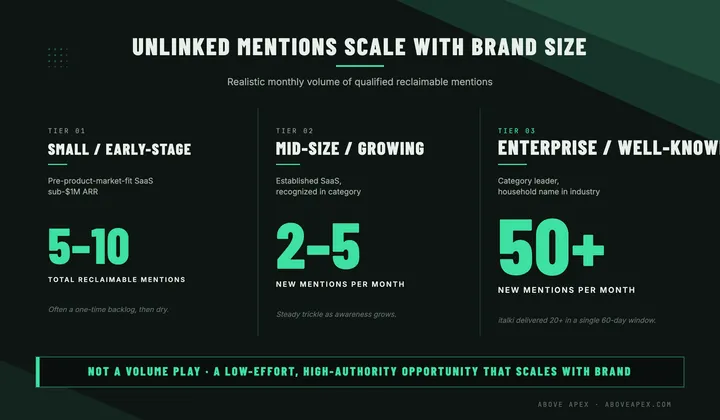
If you’re a 20-person SaaS startup, don’t build a business case around unlinked mention reclamation producing 30 links a month. Build it around producing a steady trickle of the highest-quality links in your entire backlink profile – links you literally cannot acquire through any other method.
That’s the right framing. Low effort, low volume, occasionally tier-1 results.
Real wins from Above Apex client campaigns
To show what this actually produces at the top end, here are the confirmed tier-1 wins we’ve built for clients through unlinked mention reclamation in the past year:
| Client | Publication | DR | Monthly Traffic |
|---|---|---|---|
| BigChange | The Times | 91 | 1.8M |
| Red Points | Fortune Business Insights | 86 | 107K |
| Action1 | Daily Record | 81 | 2.6M |
| Action1 | NextGov | 81 | 7.9K |
| Action1 | GovExec | 80 | 91K |
| Red Points | Times of Malta | 79 | 579K |
| Action1 | MSPoweruser | 77 | 7K |
| italki | MyUnidays | 77 | 2M |
| BigChange | Lancashire Telegraph | 74 | 151K |
| italki | Pay.com | 61 | 53K |
Every one of those placements was already on the web – sitting as an unlinked mention until we ran Ahrefs, identified the gap, and sent a short polite email asking to add a link.
How to find unlinked mentions in Ahrefs
Ahrefs has two primary features we use for this workflow: Content Explorer for finding new unlinked mentions, and Ahrefs Alerts for monitoring new mentions as they get published. Brand Radar is the newer option and increasingly what we default to for the AI citation side.
Method 1: Content Explorer with the “Highlight unlinked” filter
This is the core workflow. Step by step:
- Go to Ahrefs Content Explorer and search for your exact brand name. For example:
Stripe,italki, orRed Points. - Set the mode to “In content” – this tells Ahrefs to look for the brand name anywhere in the article body, not just in titles.
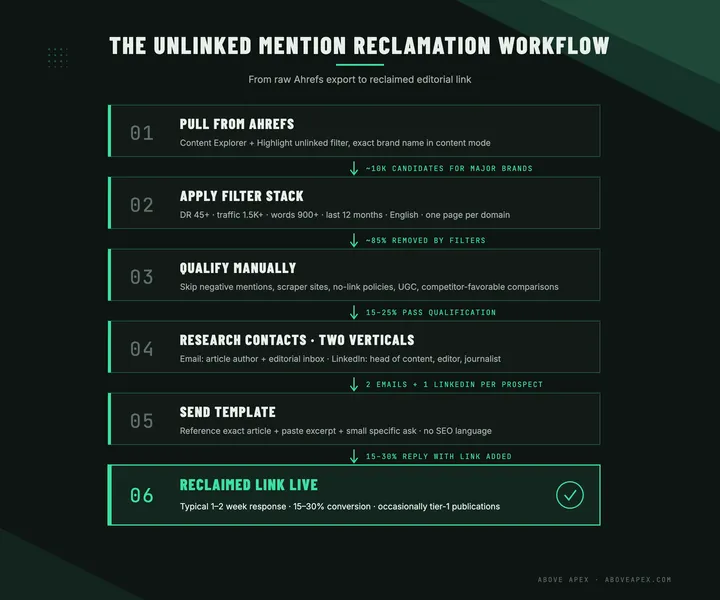
- Apply your filter stack. This is the step most people get wrong. Our baseline: DR from 45, Website traffic from 1.5K, Word count from 900, Last 12 months, English, Only live, and “One page per domain, no homepages, no subdomains.” These filters strip out the vast majority of noise before you even start prospecting.
- Add the “Highlight unlinked” filter and enter your domain (e.g.,
stripe.com). Ahrefs will highlight results where the brand is mentioned but the page doesn’t link to that domain. - Export the highlighted results to CSV. Make sure to select only pages with highlighted domains before exporting – otherwise, you’ll get thousands of rows you don’t need.
Here’s what the full setup looks like for a major brand like Stripe, which produces just under 10,000 qualifying pages with our filter stack applied:
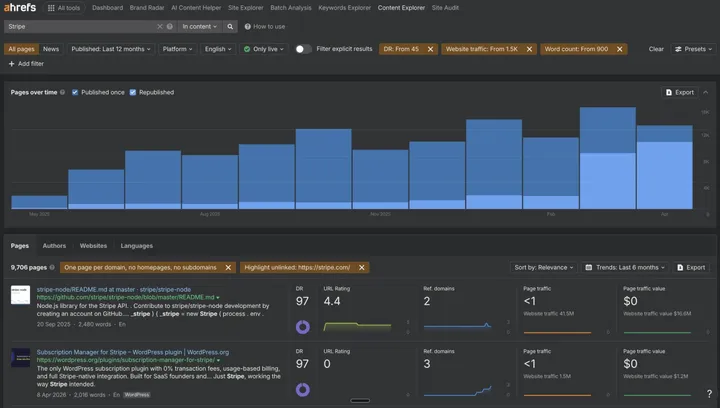
For a brand the size of Stripe, you’re looking at roughly 10,000 candidate pages after filtering. For a mid-size SaaS brand in a less crowded category, expect 100–500 pages. For a small, newer brand, sometimes under 20. The volume scales directly with brand size – which is the central reality of this tactic and the reason we treat it as a supplement to broader brand mention building rather than a standalone strategy.
Method 2: Ahrefs Alerts for ongoing monitoring
Content Explorer gives you everything that exists today. Ahrefs Alerts catches new mentions as they get published.
Set up a new Mentions alert inside Ahrefs for your exact brand name. Apply these filters:
- Mode: In content
- Language: English
- Domain Rating from: 45
- Domain traffic from: 1,500
- Words: 900+
- Exclude domain: your own (so you don’t get noise from your own site)
- Interval: Weekly
The reason to run this weekly rather than daily: new unlinked mentions typically convert at significantly higher rates if you reach out within the first few weeks of publication, before the article drops out of editorial memory. A weekly cadence is fast enough to catch them warm and slow enough that you’re not drowning in noise.
The filters that matter (and why most people get this wrong)
The biggest mistake we see in unlinked mention campaigns is running outreach on unfiltered lists. You’ll burn your sender reputation, annoy good-faith editors, and waste time chasing links that don’t move the needle. Filter aggressively before anyone pitches.
Our baseline filters at Above Apex:
- Domain Rating: 45 minimum. Below that, the link either won’t pass meaningful authority or will come from a scraper/low-quality site not worth the outreach time. Some teams go as low as DR 35 – we’ve found the sweet spot at 45 for tier-1 campaigns.
- Domain traffic: 1,500 monthly organic visits minimum. No traffic means the page is invisible to Google and the AI layer, so the link has minimal downstream value.
- Page words: 900 minimum. This is the filter almost nobody talks about, and it’s one of the most important. Short pages (under 900 words) are rarely substantial editorial pieces – they’re usually directory entries, tag pages, or thin content. The word count floor strips out 30%+ of the noise in one pass.
- Published: last 12 months. Fresh articles convert at significantly higher rates than stale ones. Editors still remember writing a piece published last week; they rarely remember one from three years ago.
- One page per domain, no homepages, no subdomains. You want the specific article page with the mention, not the homepage or every subdomain a brand has ever lived on. This filter alone eliminates thousands of junk rows for major brands.
- Only live pages. Skip 404s and dead content – no point reclaiming a link on a page nobody will ever visit.
- English-language pages only. Unless your brand operates multilingual outreach teams, stick to English-language targets. Cross-language reclamation outreach converts poorly.
After filters, our typical conversion from raw Ahrefs export to actually-worth-pursuing targets is roughly 15–25%. If you’re exporting 1,000 rows, expect to end up with 150–250 real prospects.
Contact research: the two-vertical approach
Once you have your filtered list of prospects, the next step is finding the right person to email. Most guides tell you to use Hunter or Snov and call it a day. In our experience, that leaves a lot of conversions on the table.
We run two parallel verticals for every prospect:
Vertical 1: Email
The highest-converting email target is the author of the article – the person who actually wrote the piece that mentions your brand. They wrote it, they remember the context, they can make the edit without a layer of editorial bureaucracy.
If you can find the author’s email, send to them first. Then, in parallel, send to the main editorial or contact email for the publication (usually something like editor@publication.com or listed on the contact page).
Sending to both increases your hit rate meaningfully – sometimes the author doesn’t check their inbox for weeks, but the editorial team responds within 24 hours. Sometimes the reverse. Hitting both covers your bases.
Vertical 2: LinkedIn
The second vertical is LinkedIn outreach to the right decision-makers at the publication or company. The right title varies by publication type:
- Tech companies and SaaS blogs: Head of SEO, Head of Content, senior copywriter, Content Marketing Manager
- Editorial publications (news, trade press): The journalist who wrote the piece, the section editor, and whoever handles editorial requests
- Trade publications and niche industry blogs: Editor-in-chief or founding editor – these sites are often small teams where one person controls everything
LinkedIn outreach converts well for two reasons: it bypasses spam filters that email often hits, and it’s much harder to ignore a polite direct message from a real profile than a cold email from an unfamiliar address. For high-value targets (DR 80+), we almost always run both channels in parallel.
The outreach email template we use
After testing variations across hundreds of campaigns, we’ve settled on one template that consistently outperforms the alternatives. It’s deliberately short, specific, and ends with a soft ask:
Hi [Name],
[Your name] here, from [your company].
I’m reaching out on behalf of [client brand name] who you mentioned in your article here: [specific article URL]
Here’s an excerpt from that section:
“[paste the specific sentence where the brand is mentioned]”
I am wondering if it is possible to link the words “[brand name]” in that sentence to [brand URL]?
I think this would help your visitors to find [brand name] – the company – more easily and improve UX.
Would appreciate your feedback.
Best,
[Your name]
Here are a handful of the positive replies we’ve had back from editors and authors using this exact template across different clients and publications:
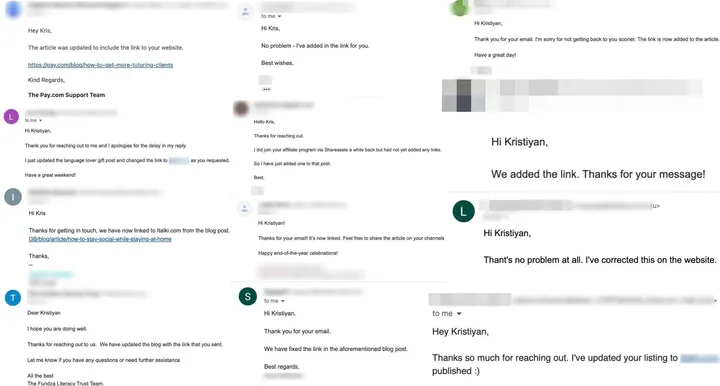
Why the template works:
- The excerpt pinpoints exactly where the mention is. The recipient doesn’t have to hunt through their own article. They see the exact sentence and know instantly what you’re referring to.
- The ask is specific and small. You’re not asking them to write something new, rewrite a paragraph, or restructure the article. You’re asking them to turn a single phrase into a hyperlink – a 5-second edit.
- The framing is reader-first. Linking “would help your visitors to find the company more easily and improve UX” – it’s true, it’s polite, and it gives the recipient a reason to say yes that has nothing to do with your SEO needs.
- No pressure, no follow-up demand. “Would appreciate your feedback” leaves the decision fully with them. No deadlines, no reciprocal offers, no pressure language.
One line we explicitly do not include: any mention of SEO, backlinks, domain authority, or link juice. The moment the recipient reads any of that, the email goes from “reader favor” to “SEO request” and the conversion rate drops sharply.
When NOT to chase unlinked mentions
Not every unlinked mention is worth pursuing. Skip these:
- Negative mentions. If the article frames your brand negatively, do not ask for a link. Reclaiming a link to a critical article amplifies a negative SEO signal.
- Scraper sites and content mills. Low DR, thin content, mass-produced articles. Even if the filter catches them, double-check before emailing.
- Sites with an explicit no-outbound-link editorial policy. Some major publications (most notably certain financial and government sites) have blanket policies against external linking. You won’t convert these no matter how polite the email.
- Mentions buried in comments or user-generated content. These aren’t editorial mentions – they’re UGC. Skip.
- Competitor comparison articles where your brand is the “worse” option. Asking for a link here just makes the comparison more visible.
Apply editorial judgment after your automated filters. The whole point of this tactic is pursuing the highest-quality links with the least friction – don’t waste outreach on junk.
What results to expect
Honest benchmarks from our client campaigns:
- Conversion rate: 15–30% on properly filtered outreach (meaning 15–30 links reclaimed per 100 qualified emails sent). Can go higher on smaller publications where the author responds directly; lower on tier-1 editorial where you’re fighting bureaucracy.
- Time to reclaimed link: Most responses arrive within 1–2 weeks. Some tier-1 outlets take 30+ days due to editorial approval processes. A small percentage come back six months later – set it and forget it.
- Volume per month: For small brands, 2–5 reclaimed links per month is realistic once the initial backlog is exhausted. For larger brands, 10–20 per month is achievable during active monitoring.
- Publication quality: Consistently the highest-DR links in the client’s backlink profile. Most of our reclamation wins are DR 60+, and a meaningful minority (5–10% in active campaigns) are DR 80+.
The single biggest predictor of success is consistency. Run the Ahrefs pull monthly, triage aggressively, send the template, follow up once, and track conversions. Teams that run it haphazardly for three months and give up see poor results. Teams that run it steadily for twelve months see it become one of their best backlink sources.
The mistakes we see constantly
Not filtering hard enough. Sending the email to every row in the Ahrefs export. You’ll hit spam traps, burn your sender reputation, and annoy editors. Filter aggressively.
Pitching a one-size-fits-all ask. The template above works because it’s specific to the exact article and the exact mention. Copy-pasted generic emails that don’t reference the specific article convert at under 3%.
Sending only to one contact. The two-vertical approach (author email + editorial email, or email + LinkedIn) converts 2–3x better than sending to just one contact per prospect.
Following up aggressively. One polite follow-up is fine. Three or four follow-ups is spam. The best unlinked mention programs respect the recipient’s time – which is partly why they work.
Treating it as a volume play. We’ve said this multiple times because it matters. This is not a scalable strategy. It’s a low-hanging-fruit tactic that occasionally lands tier-1 results. Build expectations accordingly.
Want this done for you?
For us at Above Apex unlinked mention reclamation is one of several plays we run inside our link building service. For the brands we’ve worked with, it’s typically produced the highest-DR links in the entire backlink profile – including placements in The Times, Fortune Business Insights, Daily Record, and dozens of other tier-1 publications.
If you want to see whether your brand has qualified unlinked mentions worth reclaiming, book a call here. We’ll run the Ahrefs analysis on your domain and show you what the reclaimable opportunities look like before you commit to anything.
FAQ
How is this different from regular brand mention building?
Unlinked mention reclamation only works for mentions that already exist on the web – you’re converting existing mentions into links. Brand mention building is the broader discipline of generating new mentions through expert quote outreach, listicle placements, podcast appearances, and digital PR. Reclamation is one tactic inside that broader program. For the full picture, see our guide to brand mentions for SEO.
Can I use tools other than Ahrefs for this?
Yes. Semrush’s Brand Monitoring, Mention.com, Brand24, and Google Alerts all find unlinked mentions. We use Ahrefs because the Content Explorer “Highlight unlinked” filter combined with the DR and traffic data in one interface is the fastest workflow we’ve tested. If you don’t have Ahrefs, a combination of Google Alerts plus manual DR checking via a free backlink tool will get you 80% of the way there.
How long before I see results?
First reclaimed links typically land within 2–4 weeks of starting outreach. Ranking and AI citation impact from those links shows up in the 2–4 month window after the links go live. The compounding effect (more mentions discovered each month because your brand is growing) takes 6–12 months to become meaningful.
Does this work for B2C brands too?
Yes. Everything in this guide applies to B2C – the only adjustment is that B2C brands tend to generate a higher volume of unlinked mentions from lifestyle publications and user-generated content sites, which means more aggressive filtering is required. The core workflow is identical.
What’s the minimum brand size for this tactic to make sense?
If your brand has fewer than 10 qualified unlinked mentions across the entire web, this tactic isn’t the right starting point. Focus on generating brand mentions first through expert quote outreach and listicle placements, then come back to reclamation after 6–12 months once your footprint has grown. For brands with 50+ existing unlinked mentions, this should be one of the first link building tactics you run.
Should I run this in-house or work with an agency?
The workflow is straightforward enough to run in-house if you have Ahrefs access and someone on your team who can manage prospecting and outreach. Where agencies add value is (1) existing relationships with journalists that speed up response rates, (2) established sender domains with high deliverability, and (3) the operational discipline to run it monthly for 12+ months without letting it lapse.