Key Takeaways
- Most businesses pay $150-$1,500+ per link in 2026, depending on quality, method, and industry
- Monthly agency retainers typically run $3,000-$15,000, with most quality campaigns at $3,500-$10,500/month
- Building in-house costs $17,400+/month in salaries and tools – agencies almost always deliver better output per dollar
- DR is a proxy metric, not a quality guarantee – always verify organic traffic alongside it before accepting any placement
- Publisher placement fees have increased 20-40% over the past two years as demand for quality editorial inventory grows
- Link building delivers an average ROI of 702% for B2B companies – the highest of any marketing channel tracked in 2026
- At Above Apex, we charge $400-$520 per link based on DR tier, or $3,500/month for 8 guaranteed placements
Ask three link-building agencies what their services cost, and you will get three different answers: $500/month, $5,000/month, $50,000/month. This is not just price variation. It reflects that “link building” means fundamentally different things depending on the provider.
At the bottom of the market: link farms selling placements from websites with Domain Rating 70+ for $10 a link – worthless at best, a Google penalty at worst. At the top: genuine editorial placements on HubSpot, Nasdaq, and Hootsuite earned through real outreach and original content. In between sits a spectrum of quality with no universal labelling system and no shortage of agencies willing to obscure the difference.
This guide cuts through it with real 2026 link-building pricing benchmarks, explains what drives seo link building cost up or down, breaks out what different industries should expect to budget, and shares the exact checklist we use at Above Apex to vet every placement before recommending it to a client.
Link Building Pricing at a Glance: 2026 Benchmarks
Before diving into what drives cost, here is a practical overview of what the market looks like in 2026. Link building packages prices vary significantly by method and publisher authority – here is how it breaks down.
Pricing by link-building method:
| Method | Typical Cost Range | What You Are Paying For |
|---|---|---|
| Niche edits/ link insertions | $80-$350 per link | Link placed inside existing indexed content; typically the fastest path to ranking movement |
| Guest posts (mid-tier) | $300-$800 per link | Original content published on a relevant site with genuine editorial standards |
| Guest posts (high-quality editorial) | $800-$2,000 per link | Tier-1 publications with real audiences and a high editorial bar |
| Digital PR / editorial mentions | $1,000-$3,000+ per placement | Earned brand mentions alongside industry competitors; strong AI search visibility signal |
| Monthly agency retainer | $1,500-$15,000+/month | Ongoing campaigns with strategy, volume, reporting, and account management |
Pricing by publisher domain rating (DR):
| Publisher DR | Typical Cost Per Link |
|---|---|
| DR 20-35 | $80-$200 |
| DR 35-50 | $200-$400 |
| DR 50-69 | $300-$520 |
| DR 70-79 | $400-$700 |
| DR 80+ | $500-$2,000+ |
One important caveat: DR is a proxy, not a quality certificate. We have vetted and rejected DR 75 sites with under 300 organic visitors because their traffic came from bot farms. Always verify organic traffic alongside DR before accepting any placement. A high backlink price means nothing if the site has no real audience.
How Above Apex prices it: We operate a transparent pay-per-link model – $400 for DR 69 and below, $450 for DR 70+, and $520 for DR 80+. Our fixed model is $3,500/month for 8 guaranteed placements, scalable to 2x or 3x as your needs grow. Unused monthly credits roll forward automatically. If you end the engagement, any remaining balance is refunded immediately. You only pay for links that have been successfully placed.
In-House vs. Agency: What It Actually Costs
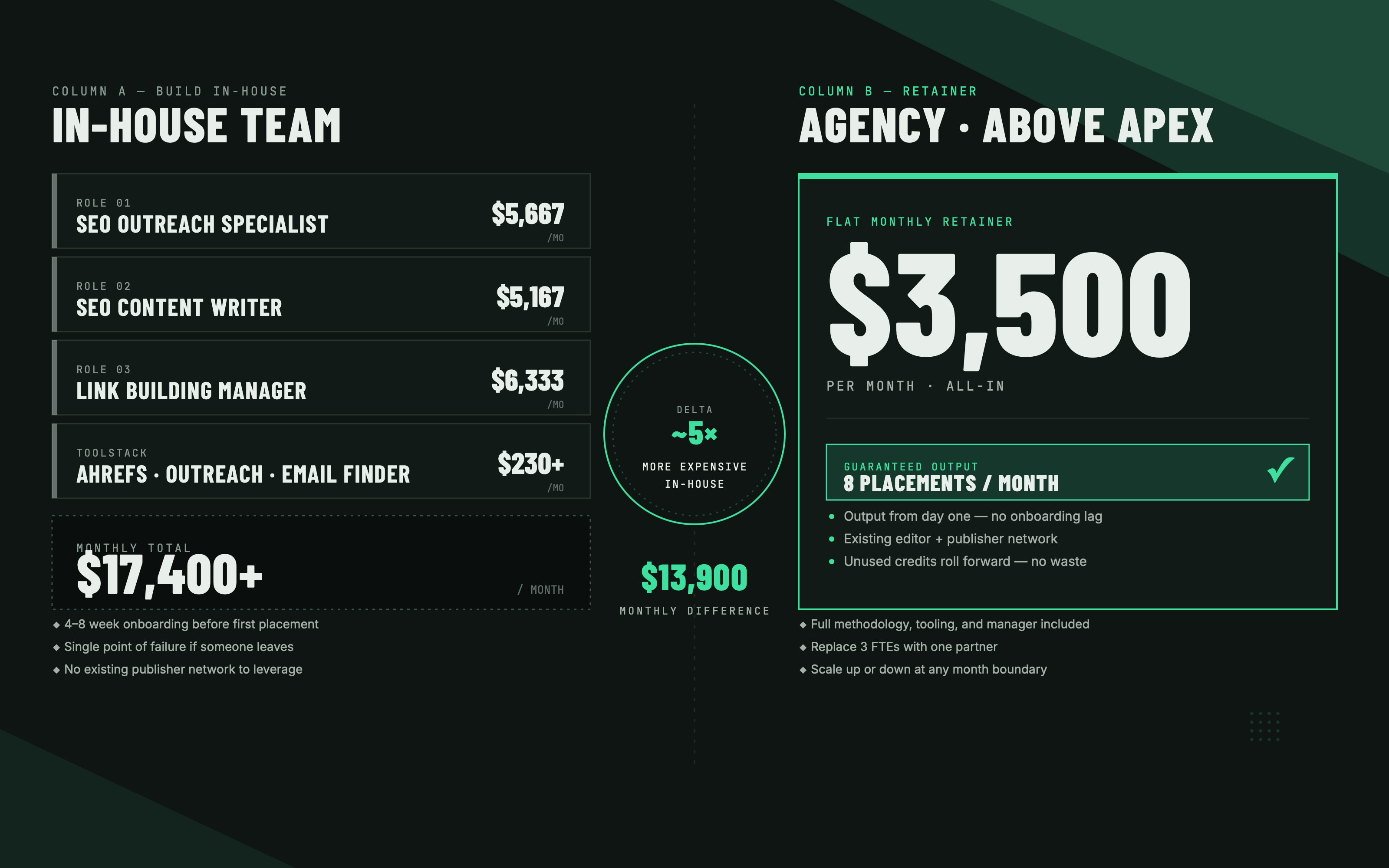
A functional in-house link-building team requires three roles at a minimum. Understanding the true link building services and building in-house is essential before making any decision.
| Role | US Average Annual Salary | Monthly Cost |
|---|---|---|
| SEO Outreach Specialist | $68,000 | $5,667 |
| SEO Content Writer | $62,000 | $5,167 |
| Link Building Manager | $76,000 | $6,333 |
| Full team total | ~$206,000/year | ~$17,167/month |
Add the essential toolstack – Ahrefs, outreach software, email finder – and you are at $17,400+/month before a single link is built. That figure does not account for a four to eight-week onboarding period, the time cost of teaching someone your specific industry, or the vulnerability of a one-person operation when that person leaves.
Running link building in-house takes longer than most teams expect. Before a single outreach email goes out, you are onboarding someone, teaching them your industry, and waiting for them to build the relationships and process knowledge that an experienced agency already has in place.
A specialised agency brings an existing network of editors, heads of SEO, and heads of content – connections built over years of campaigns that can be activated immediately. That network grows with every campaign run, meaning the access and speed compound over time rather than starting from zero with each new hire.
From a practical standpoint, plugging an agency into your process means you get output from day one without the onboarding lag, the management overhead, or the vulnerability of a one-person operation. And if you do find a specialist link building hire with the expertise to match what an agency delivers, the salary will almost certainly exceed the agency retainer, without the same bandwidth or publisher relationships behind it.
For most businesses at the growth stage, a quality agency retainer at $3,500-$10,500/month delivers better output per dollar than an in-house team costing three to four times as much.
What Drives Link Building Cost Up or Down
Your industry’s content density. Some industries are flooded with link-building outreach – publishers receive hundreds of pitches per week, acceptance rates are lower, and editorial standards are higher. Finance, legal, healthcare, and SaaS are the most expensive verticals. Expect to pay 20-40% above the average market rate in these niches.
Publisher DR and organic traffic. Higher DR costs more – but DR without meaningful organic traffic is a warning sign. A DR 70 site generating 400 monthly visitors is functionally worthless as a link source. We check both metrics on every prospective placement before recommending it to a client.
The page type being linked to. Blog posts attract links naturally and cost less. Feature pages and pricing pages are structurally harder to build links to – yet these are the pages that actually drive conversions. Expect a 20-40% cost premium when targeting product or service pages directly. Most teams build links to their blog; the higher-return play is often directing authority toward the pages that convert.
Anchor text control. Link insertions give you precise anchor text control. Digital PR placements use branded anchors chosen by the journalist or editor. Both serve different strategic purposes and are priced accordingly.
Link profile velocity of the referring domain. We review the past 12 months of every domain’s link profile growth before recommending a placement. A site that jumped from 200 to 8,000 referring domains in three months is almost certainly part of a private blog network – regardless of its current DR score.
Client approval requirements. The more approval layers in a campaign, the longer the outreach cycle, and the higher the operational cost per link placed. Streamlined approval processes produce better results per dollar.
How Much Does Link Building Cost by Industry?
The industry you operate in is one of the biggest cost drivers in any link-building campaign. Publishers receive more pitches in some niches than others, editorial standards vary, and the supply of genuinely relevant, high-authority sites differs significantly across verticals. Here is how pricing breaks down across the most common industries.
High cost industries: $300-$900+ per link
Finance, legal, healthcare, and SaaS are the most expensive niches for link building. Publishers in these spaces are flooded with outreach, enforce stricter editorial standards, and – in the case of finance and healthcare – apply YMYL (Your Money or Your Life) scrutiny to every piece of content they publish. Expect to pay a 30-50% premium above the average market rate.
| Industry | Typical Cost Per Link | Why It Costs More |
|---|---|---|
| Finance / Insurance | $400-$900+ | YMYL standards, high outreach competition, publishers frequently decline |
| Legal | $350-$800 | YMYL, limited quality publisher pool, content requires credentials |
| Healthcare | $400-$900 | Strictest editorial standards of any vertical, expert author requirements |
| SaaS / MarTech | $300-$800 | Publisher saturation, many well-funded competitors, the content bar is high |
Medium cost industries: $150-$500 per link
B2B services, ecommerce, technology, and HR are competitive but more accessible. Publisher networks are larger, more editors are open to guest contributions, and content requirements – while still demanding – are easier to meet consistently. These niches represent the best balance of cost and quality for most businesses running sustained campaigns.
| Industry | Typical Cost Per Link | Notes |
|---|---|---|
| B2B services | $200-$500 | Strong content ecosystem, good publisher availability |
| Ecommerce | $150-$400 | High volume of relevant publishers, product review sites add options |
| Technology / IT | $200-$500 | Broad niche with many sub-verticals; relevance vetting is critical |
| HR / Recruiting | $200-$450 | Active content community, good acceptance rates for quality pitches |
| Real estate | $250-$600 | Local angle can reduce costs; national campaigns run higher |
Lower cost industries: $80-$250 per link
Education, non-profit, lifestyle, and gaming benefit from large publisher pools, community-driven content cultures, and editors who are more open to link placements. Costs are lower, but relevance and quality vetting still matter – a cheap link from an irrelevant domain passes minimal authority regardless of the price.
| Industry | Typical Cost Per Link |
|---|---|
| Education | $80-$200 |
| Non-profit / Charity | $50-$150 |
| Lifestyle / Food / Wellness | $100-$250 |
| Gaming / Entertainment | $80-$200 |
A closer look at SaaS link building costs
Within the high cost tier, SaaS deserves a more detailed breakdown because costs vary significantly by sub-niche. A link-building campaign for a patch management tool competing in IT security is a fundamentally different challenge from one for a niche project management tool with thirty editorial competitors.
| SaaS Sub-Niche | Difficulty | Typical Cost Per Link |
|---|---|---|
| MarTech / Sales tools | High | $350-$800 |
| IT Security / DevOps | Medium-High | $350-$700 |
| HR tech / Recruiting | Medium-High | $300-$600 |
| FinTech / Payments | High | $400-$900 |
| Developer tools | Medium | $200-$500 |
| Vertical / niche SaaS | Low-Medium | $150-$400 |
Link building delivers an average ROI of 702% for B2B companies – the highest of any marketing channel tracked in 2026 (LinkBuildingHQ). That number compounds the more consistently you build.
What real campaigns look like: two case studies
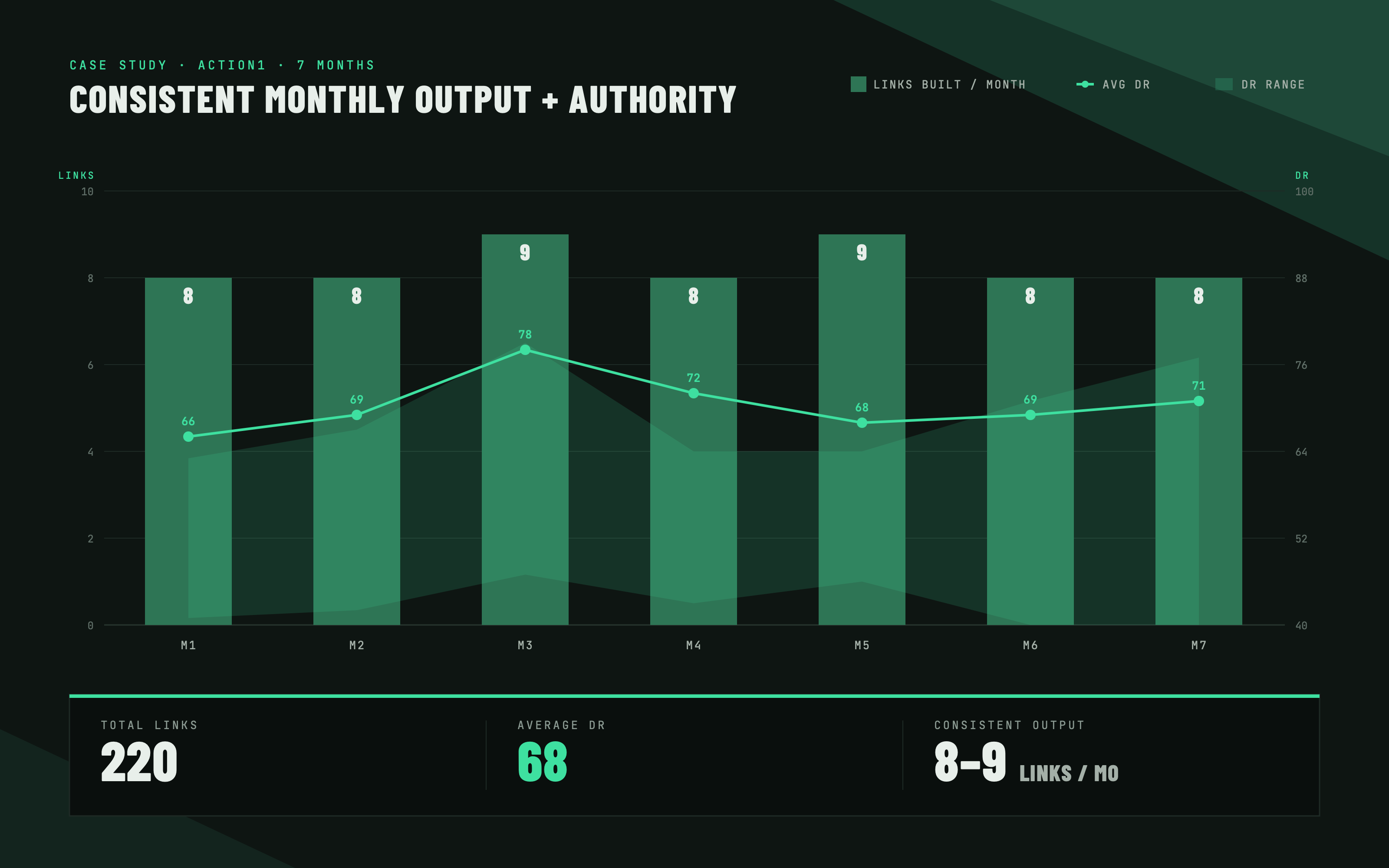
We have run link-building campaigns across both high and medium-cost verticals. Here is what consistent, quality-focused campaigns actually produce.
Action1 is a patch management and unified endpoint management SaaS in the IT security space – one of the more technically demanding verticals to build links in. Over seven months, we built 220 earned links averaging DR 68, using a mix of outreach guest posts, niche edits, and HARO-based editorial placements.
| Month | Links Built | Average DR | DR Range |
|---|---|---|---|
| Month 1 | 8 | 66 | 54-77 |
| Month 2 | 8 | 69 | 55-81 |
| Month 3 | 9 | 78 | 60-93 |
| Month 4 | 8 | 72 | 56-78 |
| Month 5 | 9 | 68 | 59-78 |
| Month 6 | 8 | 69 | 51-85 |
| Month 7 | 8 | 71 | 47-91 |
Notable placements included HubSpot (DR 93, 1.9M monthly traffic), Nasdaq (DR 90, 10.6M traffic), Hootsuite (DR 91, 1.4M traffic), and JotForm (DR 93, 1.7M traffic). Outcomes as of April 2026: organic traffic grew from 17K to 66,700+ monthly visits, 736 top-3 ranking positions, and 842 Google AI Overview citations. Estimated organic traffic value: $96,300/month.
Improvado is a marketing analytics platform. We built links on HubSpot (DR 93), Hootsuite (DR 91), Zapier (DR 91), and FlippingBook (DR 91) as part of a campaign in the MarTech space. Organic traffic grew from ~77K to 155K monthly visits, and AI citations climbed from near zero to 201 on Google AI Overviews, 301 on Gemini, and 160 on Perplexity.
Both campaigns ran at eight to nine links per month – not fifty. Quality and relevance compounded. Volume without quality does not.
“At Above Apex, we regularly see founders budget $500-$1,500/month expecting ten or more links. In a competitive niche, three to eight high-quality links per month will outperform twenty mediocre ones every time. Quality compounds. Volume alone does not.”
– Above Apex
The Red Flags That Signal You Are About to Pay for Bad Links
The cheapest links are almost always the most expensive in the long run. A placement on a link farm can trigger a Google manual penalty that takes months and significant investment to recover from – undoing years of legitimate ranking progress. Here is the eight-point checklist we run on every prospective placement before we recommend it to a client.
The Above Apex Placement Vetting Checklist:
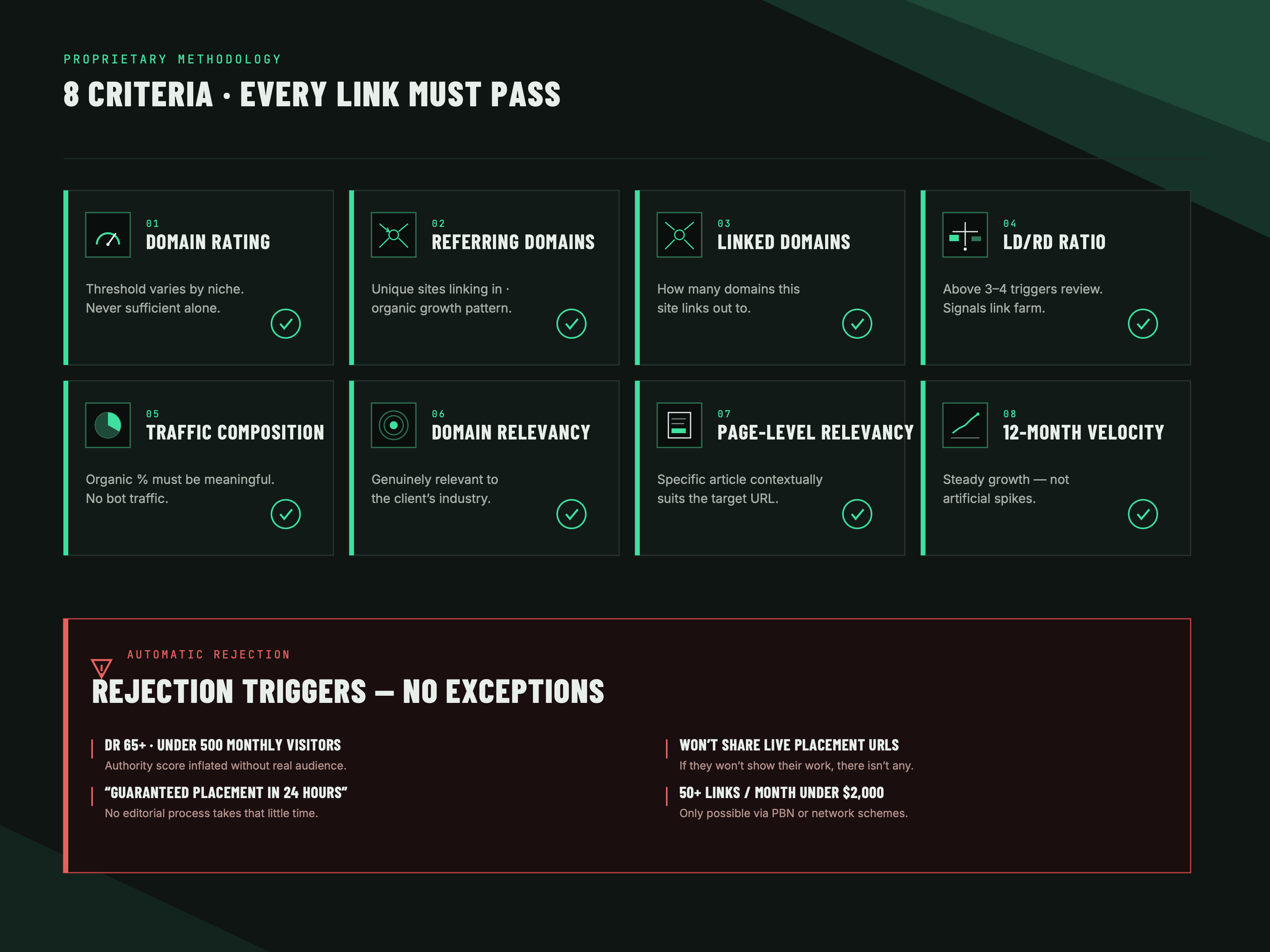
- Domain Rating (DR) – our minimum threshold varies by niche; DR alone is never sufficient
- Referring domains (RD) – how many unique websites link to this domain? Is it growing organically?
- Linked domains (LD) – how many domains does this site link out to in total?
- LD/RD ratio – a site linking out to significantly more domains than link to it signals a link farm; a ratio above 3-4 triggers our review
- Traffic source composition – what percentage of traffic is organic? Near-zero organic on a “high-traffic” site is a red flag
- Domain relevancy – is this site genuinely relevant to the client’s industry and audience?
- Page-level relevancy – does the specific article contextually suit the target URL being linked to?
- 12-month link profile velocity – steady organic growth, or an artificial spike followed by a plateau? Artificial spikes precede devaluation
Automatic rejection triggers: DR 65+ sites with under 500 monthly organic visitors; “guaranteed placement within 24 hours”; agencies that cannot provide live placement URLs before you sign; any provider offering 50+ links per month under $2,000 – the economics of legitimate outreach do not allow for this.
How to Think About Link Building ROI, Not Just Cost
76% of SEOs are willing to pay $300+ per link in 2026, with 47% willing to pay $500 or more (Reporter Outreach, 2026). Why? Because it takes an average of just 3.1 months to see a meaningful ranking jump after a link is acquired (DemandSage/Moz 2026) – and those rankings keep paying out indefinitely.
Unlike paid ads that stop the moment you stop spending, links compound. Action1’s $96,300/month traffic value did not cost $96,300/month to build. The links placed in months one through seven continue generating traffic in months eight, twelve, and twenty-four. The investment was made once. The return continues.
In 2026, quality link building also drives AI search visibility. Action1 now receives 842 citations in Google AI Overviews and appears across ChatGPT and Perplexity results – not from a separate AI strategy, but as a direct result of the editorial authority built through consistent link building. Improvado reached 301 Gemini citations and 201 Google AI Overview citations through the same process. If your buyers are searching in AI tools, this is increasingly how you appear in those answers.
What Should You Budget for Link Building?
| Growth Stage | Monthly Budget | What to Expect |
|---|---|---|
| Early stage | $1,500-$3,500/month | 3-8 quality links/month, focus on low-competition keywords |
| Growth stage | $3,500-$10,500/month | 8-24 links/month, begin targeting commercial and comparison keywords |
| Scale stage | $10,500-$20,000+/month | 24+ links/month, digital PR, competitive head terms, category ownership |
Below $1,500/month it is very difficult to run a quality campaign with consistent output in any competitive niche. Build your content foundation first – then layer in links once you have pages worth sending authority toward.
5 Questions to Ask a Link Building Agency Before You Hire
Before signing with any provider, get clear answers to these five questions:
- Can you show me live placement URLs from a recent client in my industry? Screenshots and PDFs are not sufficient. Live URLs only.
- How do you vet publisher domains before recommending them? If the answer is “DR and DA,” keep pushing. What do they check beyond the headline metric?
- What happens to unused budget or undelivered links? Credits should roll forward or be refunded – not quietly absorbed into the next billing cycle.
- What is your average DR and traffic across placements in the past 90 days? Any agency worth hiring should be able to answer this immediately without qualification.
- How do you handle a publisher removing a link after placement? Replacements should be standard policy, not a negotiation.
At Above Apex, the answer to all five is available before you sign anything.
Frequently Asked Questions
How much does link building cost per month in 2026?
Most quality link-building campaigns run $1,500-$15,000/month. For businesses at the growth stage, $3,500-$10,500/month is the most common range, delivering 8-24 placements monthly at average DR 65-75.
How much does a single backlink cost?
A quality backlink costs $150-$2,000+ depending on the publisher’s DR and organic traffic. Expect $400-$520 for placements on DR 60-80+ sites from a quality agency. Any placement under $100 from a cold pitch should be vetted extremely carefully.
How much do backlinks cost on average?
The average cost of a quality backlink in 2026 sits between $300 and $500 for a mid-tier placement on a DR 40-60 site with real organic traffic. Budget placements start around $80-$150 but carry quality and penalty risk. Premium editorial placements on DR 80+ sites cost $800-$2,000+. The wide range reflects the equally wide range in quality – price per link is only meaningful alongside DR, traffic, and relevance data.
Is cheap link building worth it?
Rarely. Low-cost links almost always come from link farms or private blog networks – they carry minimal ranking signal and significant penalty risk. The cost of recovering from a Google manual action almost always exceeds the cost of doing link building correctly from the start.
How long does it take to see results from link building?
On average, 3.1 months to see a noticeable ranking jump after a backlink is acquired. Meaningful organic traffic growth typically compounds from month six onwards. Long-tail, lower-competition keywords respond faster; competitive head terms take longer but deliver proportionally higher returns.
What is the difference between a guest post and a niche edit?
A guest post is original content published on a third-party site with a link back to your target page. A niche edit places your link inside an existing, already-indexed article. Niche edits typically produce faster ranking movement. Guest posts offer more control over the content surrounding your link.
Do I need to keep building links forever?
You do not need to build at the same pace indefinitely – but stopping entirely in a competitive niche will eventually allow competitors to close the gap. A maintenance pace of three to five quality links per month typically preserves rankings once you have reached your targets.
What is a good DR for a backlink?
DR 40-70 with genuine organic traffic is the sweet spot for most campaigns – enough authority to pass real ranking signal, accessible enough to build at consistent volume. DR 80+ placements are highly valuable but harder to scale. Never evaluate DR without also checking organic traffic.
How do I know if a link-building agency is legitimate?
Ask for live placement URLs from recent clients in your industry – not screenshots or PDFs. Ask how they vet publishers beyond DR. Ask what happens to undelivered links. Any agency that cannot answer these questions immediately and clearly should be approached with caution.
Should early-stage businesses invest in link building?
Build your content foundation first. If you have fewer than ten to fifteen substantive pages worth building authority toward, invest in content before links. Once the foundation exists, even modest link building targeting low-competition keywords can produce measurable ranking movement within 90 days.
How much have link-building prices changed recently?
Publisher placement fees have increased 20-40% over the past two years as webmasters increasingly recognise the commercial value of their editorial inventory. Budgets that produced strong results in 2023 or 2024 typically need adjusting upward for 2026 rates, particularly in competitive niches.