Key Takeaways
- Guest posts and niche edits both build backlinks but work differently in terms of speed, cost, and scalability
- Guest posts are slow to implement – 2-3 per month is a realistic strong result – because multiple people on both sides must align at every stage
- Niche edits sourced through competitive analysis come pre-validated for relevancy, effectiveness, and probability of inclusion before a single email is sent
- The ranking advantage of niche edits is compounding: you build more, faster, so link equity accumulates faster
- At Above Apex, our campaigns typically run 80-90% niche edits across six distinct types, with guest posts as a complement
- Listicle inclusions and HARO editorial placements are the most direct routes to AI Overview citations in 2026
- In most competitive markets, niche edits should be your foundation – guest posts are valuable but very difficult to scale
Almost every new client who comes to Above Apex arrives with the same assumption: guest posts should be the primary link-building strategy. It makes intuitive sense. Guest posts are the most discussed method, the name is familiar, and the process seems straightforward. They can also genuinely produce excellent links.
But the conversation shifts quickly when we walk them through how competitive analysis-driven niche edits actually work in practice – how much of the research and validation is already done before a single outreach email is sent, and how fast high-quality placements start appearing alongside competitors on sites they recognise. The question usually stops being “should we try niche edits?” and becomes “why weren’t we doing this already?”
This article gives you our honest answer to guest posts vs niche edits. Not the diplomatic “both have their place” version you will find everywhere else. We will explain how each method actually works, why we run campaigns at 80-90% niche edits, what the six types of niche edits are, and the specific situations where guest posts are genuinely worth the extra time and investment.
What Each Method Actually Is
Guest posts and guest posting for SEO
Guest posting is the practice of writing and publishing original content on another website in exchange for a contextual link back to your website. The host site gets fresh content; you get a link and exposure to their audience. When done on genuinely relevant, high-authority sites, the link carries real weight – both in terms of the authority it passes and the brand visibility it creates.
The process: identify target sites, pitch topics, agree on content criteria, write the article, go through editorial review, and wait for publication. Each stage involves different people on both sides and can stall independently. Getting two to three guest posts live per month is a genuinely good result – not a criticism of the method, but a reflection of how many dependencies are involved at every step.
What are niche edits?
A niche edit – also called a link insertion or curated link – places your link inside an existing, already-indexed article on another website. No new content is required. The host page already has authority, trust, and often traffic. Your link benefits from all of that immediately upon placement.
Most articles treat niche edits as a single method. In practice, they are a category that covers six distinct tactics – and the difference between them matters significantly in terms of quality, scalability, and the type of visibility they produce.
The Above Apex niche edit framework – six types:
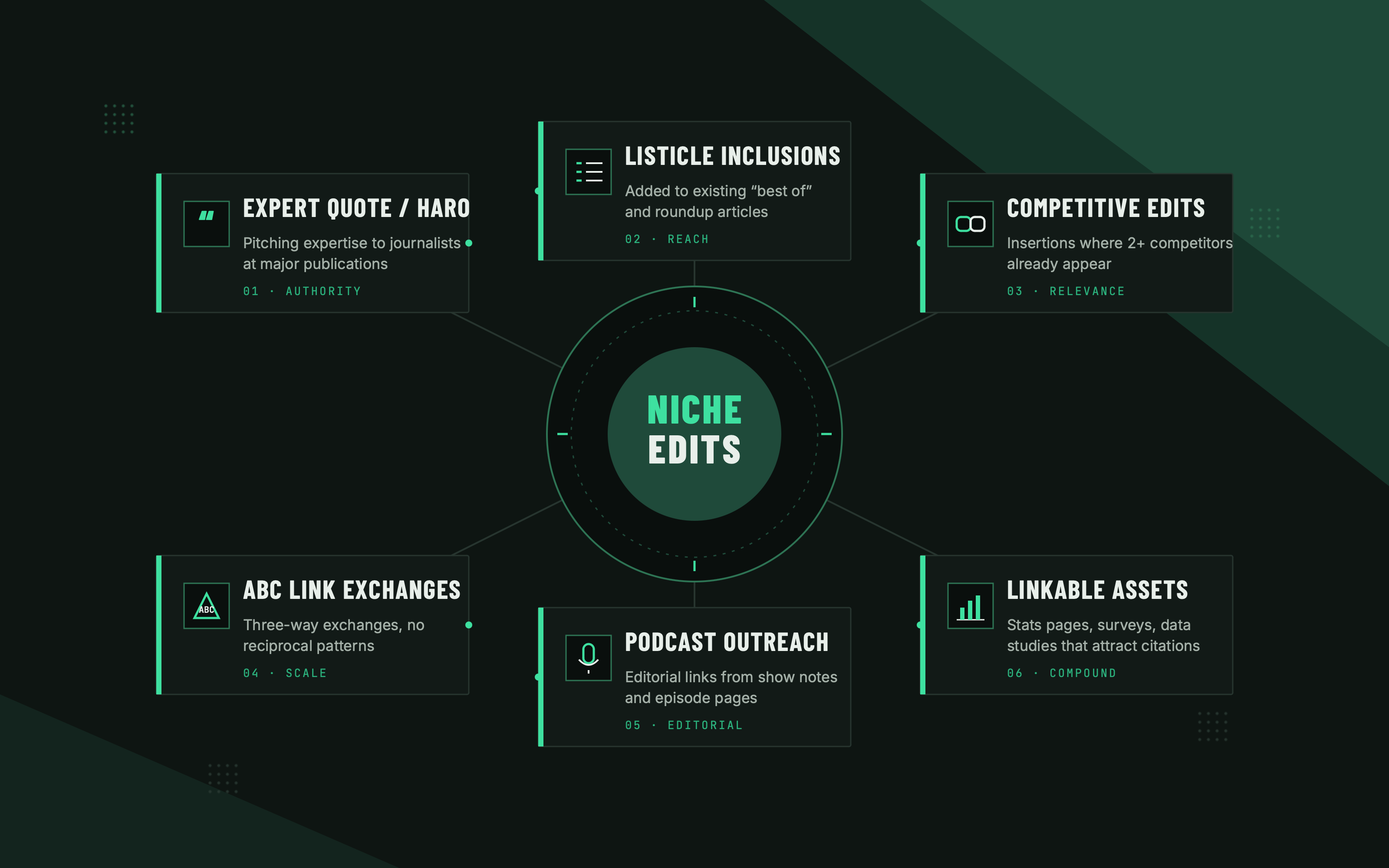
- Expert quote / HARO outreach – pitching your expertise to journalists and editors requesting sources for articles in major publications
- Listicle inclusions – getting your brand listed in existing “best of” and roundup articles in your category
- Competitive niche edits – link insertions in articles where two or more competitors are already mentioned
- ABC link exchanges – three-way exchanges that avoid direct reciprocal linking patterns
- Podcast outreach – getting featured as a guest to earn editorial links from show notes and episode pages
- Linkable assets – statistics pages, original surveys, and data studies that attract organic citations over time
Most link-building companies running niche edits are only working with type 3 – basic competitive insertions. The full picture is considerably broader and, when used together, produces significantly more compound impact.
The Core Differences: Speed, Cost, and Scale
| Factor | Guest Posts | Niche Edits |
|---|---|---|
| Time to implement | 3-8 weeks typically | Days to 2 weeks |
| Realistic monthly volume | 2-4 links | Significantly more |
| Content requirement | Full original article (1,200-2,000+ words) | None – existing content used |
| Typical cost per link | $300-$2,000+ | $150-$600 |
| Anchor text control | Full | Full |
| Content context control | Full – you write it | Limited – existing article |
| Authority source | New page (builds authority over time) | Aged page (authority already established) |
| Scalability | Low | High |
| Best for | Brand building, E-E-A-T, specific high-DR targets | Foundation, volume, ROI, competitive markets |
A note on ranking speed that most comparison articles get wrong: niche edits are faster to implement, but that does not automatically mean faster ranking results. What it does mean is that a consistent niche edit programme accumulates link equity faster than a guest post programme running at the same effort level. The ranking benefit flows from compounding volume and consistency – more links placed consistently over time – rather than from any inherent property of the link type itself.
Guest posts depend on multiple people on both sides simultaneously: topic alignment, content criteria, writing, editorial review, and publication scheduling. Each stage can stall, and often does. Two to three guest posts live per month is a strong result. Not a criticism – just the structural reality of how many dependencies are involved. Niche edits, particularly through competitive analysis, remove most of those dependencies. A placement can go live within days of the initial conversation.
For a full breakdown of what each method costs at different quality tiers, see our link-building pricing guide.
The Competitive Analysis Approach: Why This Changes Everything
Most people approach niche edits by identifying relevant sites and requesting link insertions on a case-by-case basis. That works, but it requires extensive manual vetting of every prospect from scratch. The approach we use at Above Apex is different – and it is why niche edits are so much more scalable than most teams experience them to be.
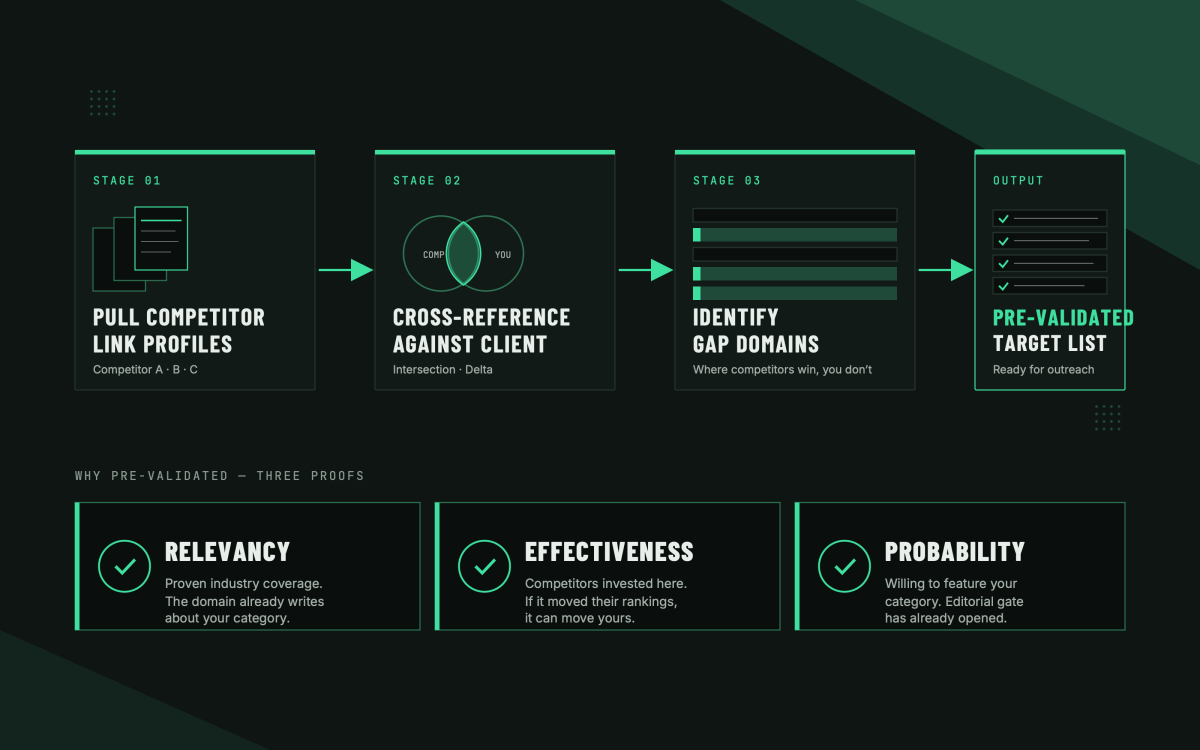
The process starts with the client’s competitors – direct and indirect. We pull their combined link profiles. Cross-reference against the client’s own profile to identify domains where two or more competitors already have links, but the client has zero presence – on both a domain and page level. That becomes the outreach list.
Before a single email is sent, three things are already validated:
1. Relevancy is pre-validated. If multiple competitors are featured on a page, that site is actively covering your industry and addressing your type of solution. You are not hoping the site is relevant – you have evidence it is.
2. Effectiveness is pre-validated. Your competitors do not place links on sites that produce no results. If they invested in getting listed there, those placements are working. You are targeting opportunities with a demonstrated track record.
3. Probability is pre-validated. A site that has featured two or three companies in your space has already demonstrated a willingness to include businesses like yours. Cold outreach to a site with no prior relationship to your industry is a much harder conversation.
“With niche edits via competitive analysis, 90% of the research and validation is done before you send a single email. You’re not prospecting blind – you’re executing against a roadmap your competitors have already built for you. The only work left is outreach and relationship building, which is where the actual craft of link building lives.”
– Above Apex
The scale advantage in competitive markets is significant. In saturated industries where multiple players are actively investing in link building, the number of pre-validated targets this method surfaces can be very large. The more competitive your market, the more your competitors have already mapped the opportunity landscape. This is one of the reasons we lean so heavily toward niche edits in competitive markets – it is not just that they are easier to execute, it is that the available target pool in those markets is enormous.
This is also why the 80/20 split in favour of niche edits exists. Not because guest posts are ineffective – but because in most competitive markets, the niche edit pipeline is larger than the capacity to execute it. The question is rarely whether enough opportunities exist. It is how quickly you can work through the pre-validated list you already have.
What Guest Posts Are Actually Good For
The honest answer to guest posts vs niche edits is not that one method is universally better. It is that they serve different purposes, and the proportions should reflect where the bigger opportunity sits for your specific situation.
Guest posts are genuinely the right choice in four situations:
1. Very high-authority domains that do not accept link insertions. Some of the most valuable publishing sites in any industry only accept original contributed content. If a DR 80+ site that is highly relevant to your audience publishes guest pieces but not link insertions, that link is too valuable to leave behind because the process is inconvenient. A well-placed guest post on a domain like that is worth the extra time and content cost.
2. Brand building and E-E-A-T signals. A guest post with your name, credentials, and genuine expertise attached does something a niche edit cannot: it builds your author entity and brand presence in the eyes of both search engines and readers. If author credibility matters in your market – think health, finance, legal, or any high-trust B2B sector – guest posts on relevant publications contribute to E-E-A-T in a way link insertions simply do not.
3. Content narrative control. Guest posts let you choose the topic, craft the argument, and control everything that surrounds your link. For very specific brand positioning, or for targeting a precise topical angle that does not yet exist in published content, that control is worth the additional overhead.
4. Very niche industries with limited competitor link data. In emerging or highly specialised markets where few established competitors have deep link profiles, the competitive analysis approach may not yield enough pre-validated targets. Guest posts become proportionally more important here – there simply is not enough existing competitor data to mine.
“Guest posts are the cherry on top of a consistent, scalable niche edit programme. Even a couple of strong guest post links per month, layered on top of your regular niche edit volume, is a genuinely great outcome. But they are very difficult to build a primary link building strategy around because of how hard they are to scale.”
– Above Apex
How Each Method Affects AI Search Visibility in 2026
This is a dimension of the guest posts vs niche edits debate that almost nobody is discussing yet – and it is increasingly important as AI search tools become a significant discovery channel for many markets.
Different link types affect AI visibility in different ways, but all of them feed into the same interconnected system.
Expert Quote Placement (HARO-type links) on major publications produce two effects simultaneously. The high-DR link improves your SERP rankings. The brand mention builds your topical entity – a signal that both Google and AI models use to understand your brand’s relevance and authority in a given category. According to a study done by Ahrefs, 76% of what appears in AI Overviews is drawn from organic SERP results, which means improving rankings also improves AI citation rates. The brand mention layer adds a second path: appearing in queries your site may not rank for directly.
Listicle inclusions are among the most direct routes to AI Overview citations for category-level queries. When someone asks an AI tool what the best option in a category is, those tools largely pull from existing roundups and comparison articles. Getting listed in “Best [Category] Tools 2026” articles through niche edit outreach is the most direct link building tactic for AI search visibility. This is something we have seen consistently across campaigns.
Standard niche edits work more indirectly – they build domain authority, which improves rankings, which feeds into AI citation rates. The effect is real but one step removed from the brand mention and listicle inclusion effects.
All three types work. Some are more direct, some more indirect. None operates in isolation – they compound together when you run them consistently as part of the same programme.
“About 70% of what shows up in AI Overviews is fed from organic SERP. Build links that improve your rankings and you’re improving your AI citation rate automatically – before a single brand mention is earned. The brand mentions from HARO and editorial placements then add a second layer on top. All of these effects are interconnected. They just enter the same system at different points.”
– Above Apex
A real example: one of our clients, Improvado (a marketing analytics platform), grew from near-zero AI citations to 201 on Google AI Overviews, 301 on Gemini, and 160 on Perplexity. Those results came from a combination of factors working together – the link-building campaign, HARO-type editorial placements, listicle inclusions, the Improvado team’s own PR activity, and a technically solid website. The link building – particularly the editorial placements and listicle inclusions – was a significant driver, but it worked within a broader marketing ecosystem. That is how compounding link building actually works in practice.
The Honest Recommendation: What We Actually Do
In a competitive or saturated market, where multiple players are actively investing in SEO and link building, the starting point is always the same: competitive analysis, niche edits.
We pull the client’s competitor link profiles, identify the pre-validated targets, build the outreach list, and start executing. Expert outreach and listicle inclusions run alongside that as the programme builds momentum. Guest posts are added on top when capacity allows and when specific high-authority targets are identified that only accept original content.
The typical split is 80/20 in favour of niche edits, sometimes 90/10. Within that niche edit majority of all six types are used in proportion to what the client’s market and situation call for.
We rarely encounter a competitive market where this framework does not apply. The targets are in the competitors’ link profiles. The validation is built in. The opportunity is usually larger than the capacity to execute it. Guest posts are a great addition – a few strong ones per month, layered on top of a consistent niche edit programme, is the combination that compounds fastest.
What This Looks Like in a Real Campaign
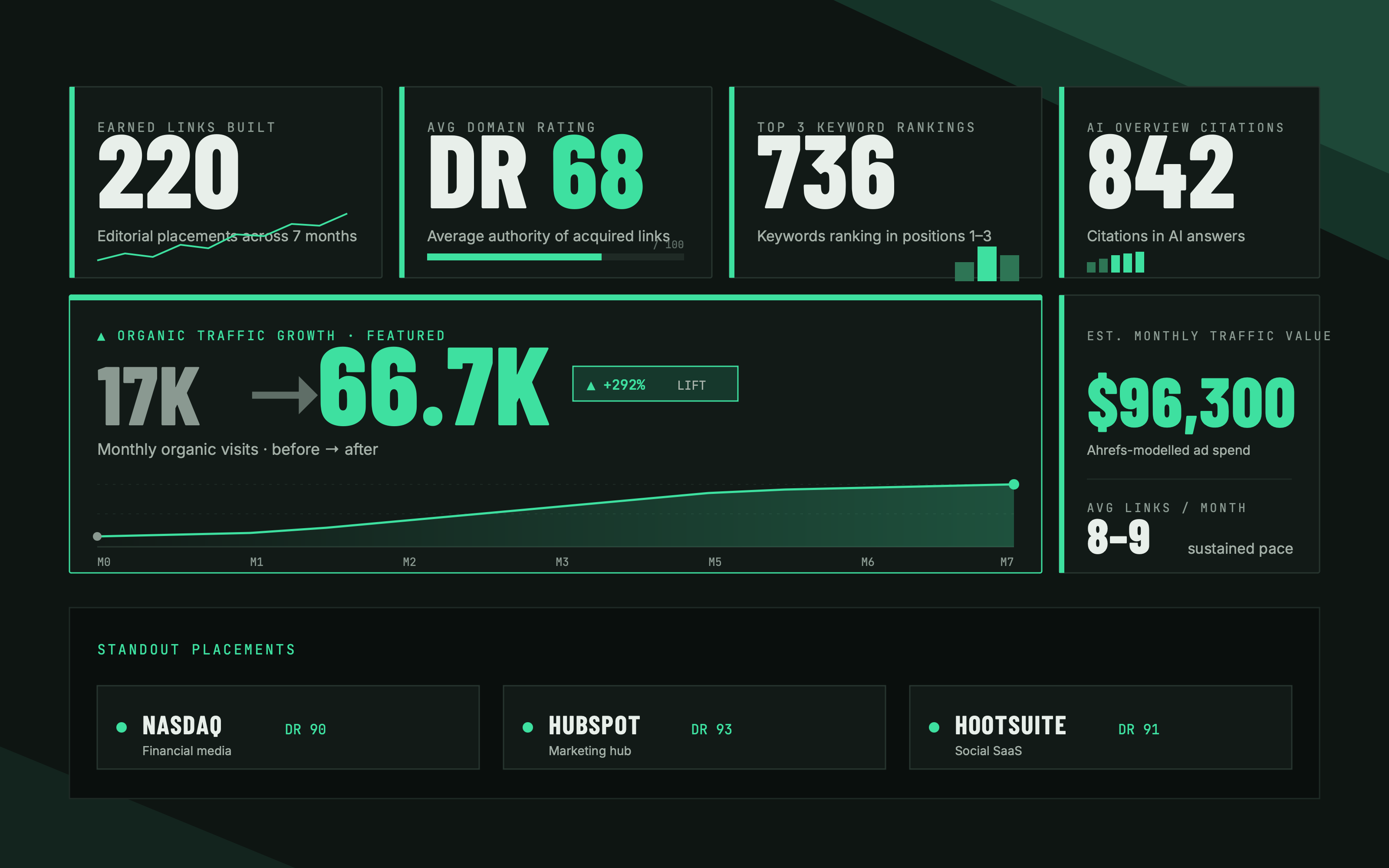
The Action1 campaign – a patch management SaaS in the IT security space, one of the more competitive verticals to build links in – gives a concrete picture of how this plays out.
Over seven months, we built 220 earned links, averaging DR 68. The campaign ran across multiple niche edit types: expert quote placements on Nasdaq (DR 90, 10.6M monthly traffic), HubSpot (DR 93, 1.9M monthly traffic), and Hootsuite (DR 91, 1.4M monthly traffic) through HARO outreach; listicle inclusions in IT security and endpoint management roundups; and competitive niche edits across the target domain list built from competitor link profile analysis. Guest posts were used selectively for specific target domains that only accepted original contributions.
The result: organic traffic grew from 17K to 66,700 monthly visits. 736 keywords in the top three positions. 842 Google AI Overview citations. Estimated organic traffic value of $96,300 per month.
That was built with eight to nine links per month – not fifty. The compound effect of consistent, quality placements at that pace produced those results.
How to Choose for Your Situation
Start with niche edits as your foundation if: you are in a competitive or saturated market with multiple established players actively building links; you need to show meaningful results within 60-90 days; your content creation budget is limited; or competitor link profile analysis surfaces 30 or more pre-validated target domains.
Weight guest posts more heavily if: your industry is very niche with few established competitors and limited link profile data to mine; specific very high-authority domains relevant to your audience only accept original contributed content; building author credentials and E-E-A-T signals is a primary objective; or you have existing publisher relationships you can leverage.
In almost every competitive market, the answer is: build the niche edit foundation first, then layer in guest posts. A few strong guest posts per month on top of a consistent niche edit programme is the combination that compounds fastest – and it is the one we run for our clients.
Frequently Asked Questions
What is the difference between niche edits, link insertions, and curated links?
They are all the same thing – different names for the same strategy. A niche edit, link insertion, and curated link all refer to placing your backlink inside an existing, already-published article on another site. The terminology varies by link-building vendors and market but the method is identical.
Are niche edits safe? Do they risk a Google penalty?
Niche edits are safe when executed correctly – meaning manual outreach to real, editorially-controlled sites with genuine organic traffic and relevant content. The risk comes from low-quality execution: paying for placements on private blog networks, inserting links on irrelevant sites, or using automated link placement tools. White-hat niche edits on properly vetted sites are a legitimate, widely-used link-building method.
How quickly do niche edits typically go live compared to guest posts?
Niche edits typically go live within days to two weeks from the initial outreach conversation. Guest posts – because they require topic alignment, content creation, editorial review, and publication scheduling across multiple people on both sides – commonly take three to eight weeks from outreach to live link. This implementation speed difference is one of the primary practical advantages of niche edits at scale.
Which is cheaper – guest posts or niche edits?
Niche edits are generally cheaper per link because no content creation is required. Typical niche edit placements on quality sites run $150-$600 per link. Guest posts on equivalent sites typically run $300-$2,000+ per link because the cost includes content creation and placement. For a full breakdown by method, DR tier, and industry, see our link building pricing guide.
What makes a niche edit opportunity worth pursuing?
The key criteria are: the host page has genuine organic traffic (not just DR), the content is topically relevant to your target URL, the site is not participating in link schemes or excessive paid placement, and – ideally – the page already features competitors or brands in your space. A niche edit in a page that two or more competitors appear in is worth significantly more than a generic insertion on an unrelated article.
Can guest posts hurt my site if done at scale?
Yes, if done without care. Guest posts on irrelevant sites, sites with obvious paid placement patterns, or sites that publish indiscriminate guest content regardless of quality can trigger algorithmic and manual penalties. The risk increases when guest posts are the dominant link-building tactic run at high volume, because the pattern becomes easier for Google to identify. Diversifying across link types – as described in this article – reduces that pattern risk.
Should I do both guest posts and niche edits in the same campaign?
In most cases, yes – but in very different proportions than most people default to. The most effective campaigns we run use niche edits (across all six types) as the primary volume driver, with guest posts added selectively for specific high-authority targets or brand-building objectives. Running both in a roughly equal split tends to mean underinvesting in the method that scales better and overinvesting in the method that is harder to sustain at volume.
How many links per month does it take to see ranking movement?
There is no universal number – it depends on your domain’s current authority, the competition level for your target keywords, and the quality of the links being built. In most competitive markets, eight to fifteen high-quality links per month from genuinely relevant, authoritative sites will produce measurable ranking movement within three to six months of consistent building. Fewer links of higher quality consistently outperform larger volumes of lower-quality placements.
What is the best way to find niche edit opportunities?
The most effective starting point is your competitors’ link profiles. Pull the referring domains from two or more of your closest competitors, identify pages where multiple competitors appear but you have no presence, and build your outreach list from those targets. Relevance, effectiveness, and probability are all pre-validated before you send a single email. It is the most efficient niche edit prospecting method available, particularly in competitive markets.
How do guest posts and niche edits differ in terms of AI search visibility?
They affect AI visibility differently, but both contribute to it. HARO and editorial placements on major publications produce brand mentions that help you appear in AI-generated answers even for queries you do not rank for directly. Listicle inclusions – getting listed in category roundup articles – are the most direct route to AI Overview citations for category-level searches. Standard niche edits build domain authority, which improves SERP rankings, which in turn feeds AI citation rates. All three contribute to the same system; they just enter it at different points.