In a category owned by OneTrust, BigID, and TrustArc for the better part of a decade, a data privacy platform called Ketch showed up in Google’s AI Overview for “best data privacy management platforms” – listed second. Named alongside the category leaders.
Not because Ketch outspent the incumbents. Not because they had a bigger team. Not from a viral campaign or a PR stunt.
They got there through one thing: a systematic off-page presence. Earned mentions in listicles, podcasts, editorial pieces, and tech publications – the exact kinds of sources Google and LLMs already trust. Rankings followed. Position 9 to 1 on “data privacy software.” Position 9 to 1 on “privacy compliance software.” Position 28 to 4 on “data privacy platform.” And AI visibility compounded from there: 120 Google AI Overview citations across the most competitive queries in the space.
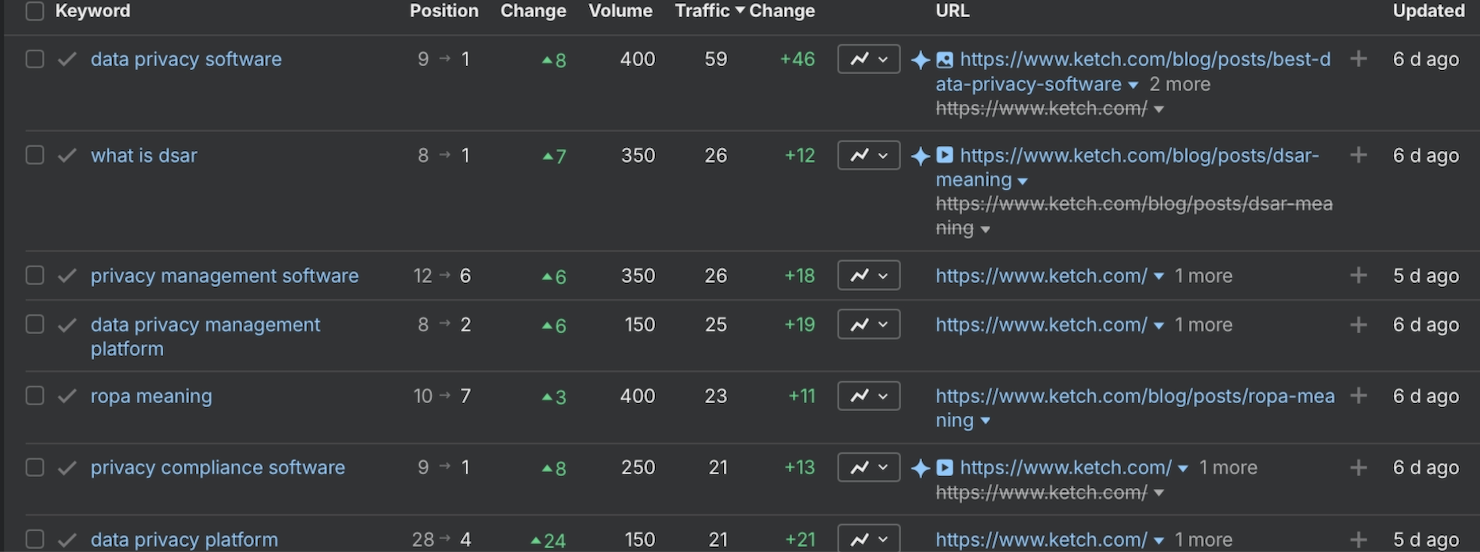
This is what brand mentions do when they’re built correctly.
At Above Apex, we’ve built over 500 brand mentions for SaaS brands in the past 18 months – 250+ from expert quote outreach alone, the rest from listicle placements, digital PR, and editorial outreach. We’ve placed clients in HubSpot, Zapier, Fast Company, GoDaddy, Shopify, Hootsuite, Semrush, Yahoo, AOL, and dozens of other DR 80+ publications.
This guide is what we’ve learned about how brand mentions actually move SEO needles in 2026, with the process, numbers, and case studies behind it.
What counts as a brand mention?
A brand mention is any online reference to your company, product, or service across the web – in articles, reviews, forum threads, podcasts, social posts, AI answers, and every other surface where people talk about brands.
For SEO, three types matter:
Linked mentions. The reference includes a clickable link to your site. These still carry most of the direct SEO weight – they pass authority, drive referral traffic, and reinforce the brand signal.
Unlinked mentions. Your brand name appears without a hyperlink – a mention in a Forbes article, a Reddit thread, or a YouTube video description. Google can still connect these to your entity and factor them into how confidently it ranks and describes you.
Implied mentions. Someone describes your product, category position, or category leadership without naming you directly. Harder to track, but increasingly relevant as search engines and LLMs reason about entities rather than exact-match strings.
Add a fourth category for 2026: AI citations. When ChatGPT, Perplexity, Google AI Overviews, or Google AI Mode reference your brand inside an answer, that’s a mention – and it’s becoming the single most valuable surface in all of search.
Why brand mentions matter more in the AI era
The traditional case for brand mentions has been around for years: they build entity authority, reinforce E-E-A-T, correlate with better rankings, and help search engines understand who you are and what you’re known for.
That case hasn’t changed. Links still help you rank. Mentions in trusted publications still strengthen how Google interprets your brand. Unlinked mentions still feed the knowledge graph. All of that is still true.
What has changed is what sits on top of it.
AI Overviews and LLMs pull from sources Google already trusts
When someone searches “best data privacy management platforms” and gets a Google AI Overview, the system isn’t generating a neutral opinion out of thin air. It’s synthesizing content from the sources it has been trained to trust – listicles, editorial reviews, Reddit threads, comparison pages, expert quotes in industry media.
ChatGPT and Perplexity work on a similar principle. They pull from the sources that have the strongest signals of authority and relevance for a given query.
If your brand isn’t present in those sources, you don’t get cited. It doesn’t matter how good your product is, how much you spend on ads, or how strong your on-page SEO is. If the AI layer doesn’t see your brand mentioned across the sources it reasons from, you’re invisible in AI answers.
This is the shift that took brand mentions from “a nice signal to have” to “the mechanism by which AI visibility is won or lost.”
The numbers from three recent clients
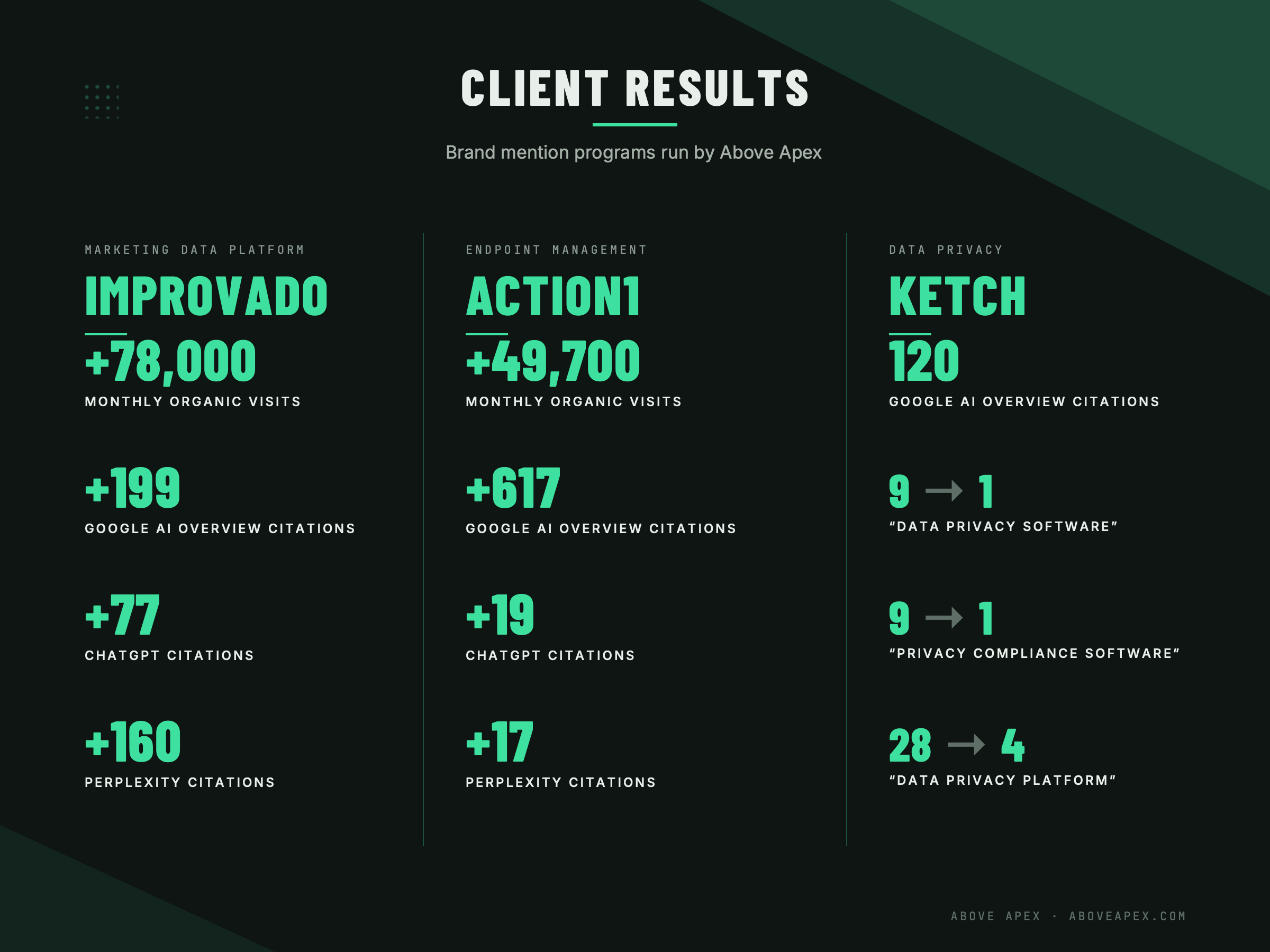
Here’s what this looked like for three SaaS companies we ran brand mention programs for:
Improvado (marketing data platform): After a systemized link-building campaign, including expert quote and listicle campaigns, they added +78,000 monthly organic visits, +199 Google AI Overview citations, +77 ChatGPT citations, and +160 Perplexity citations.
Action1 (unified endpoint management): +49,700 monthly organic visits, +617 Google AI Overview citations, +19 ChatGPT citations, and +17 Perplexity citations.
Ketch (data privacy): 120 Google AI Overview citations across the most competitive queries in their category, plus the position jumps mentioned above – 9 to 1, 9 to 1, and 28 – 4 on their three highest-priority commercial keywords.
In every case, the brand mention work wasn’t a standalone tactic. It was the connective tissue between content, on-page SEO, and AI visibility. Content told Google what the brand did. Brand mentions told Google – and the LLMs – that other authoritative sources agreed.
The framework that actually works: entity coverage
Most guides on brand mentions give you a process for chasing high-DR links and hoping the needle moves. That’s table stakes. It’s not the framework.
Here’s the framework we use, and it’s the single most important thing in this guide:
Be present in every single place your biggest competitors are.
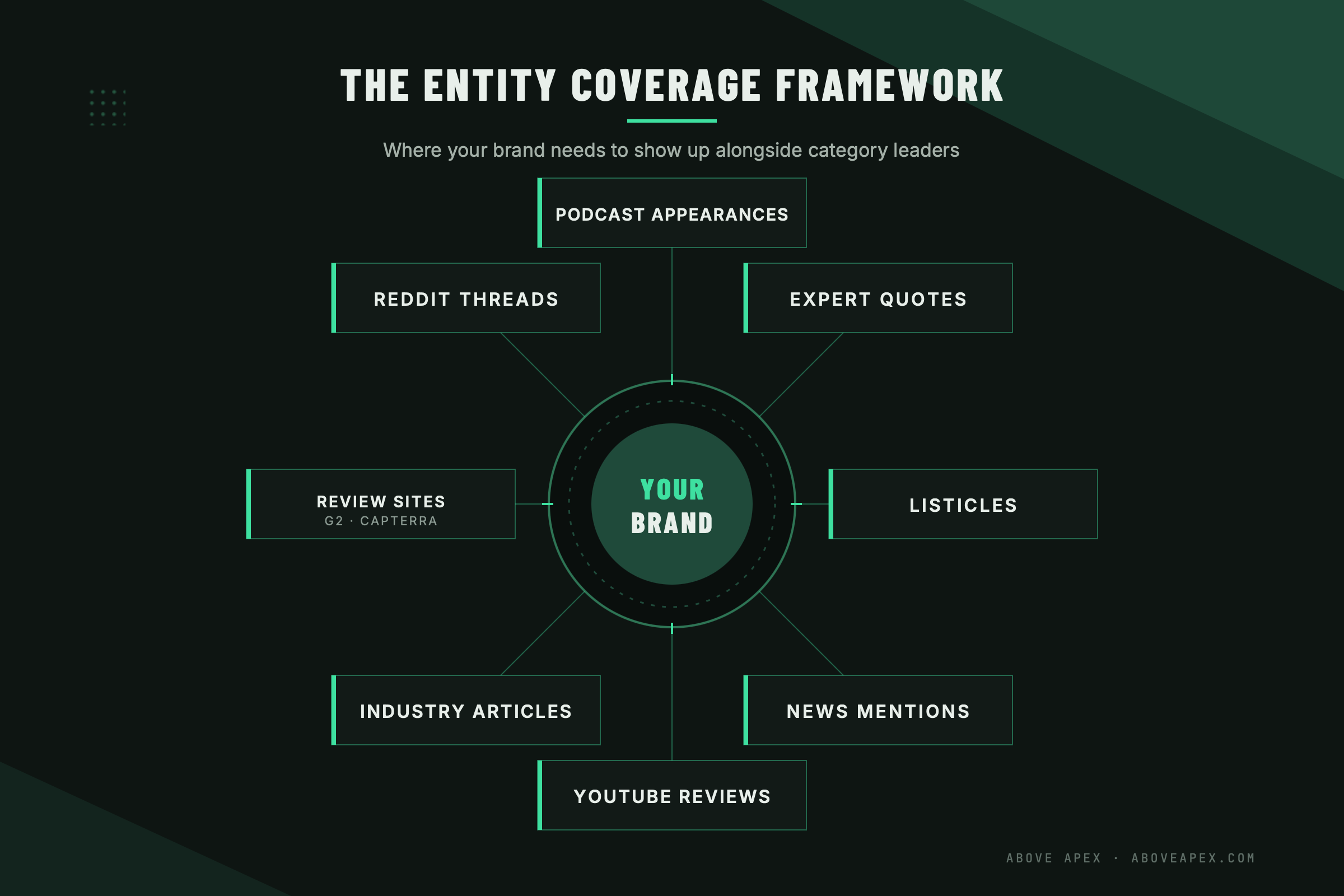
In every SaaS category, there are a handful of dominant players. OneTrust in data privacy. HubSpot in marketing automation. Salesforce in CRM. ClickUp and Asana in project management. These brands don’t just rank well – they’re everywhere. They appear in the top 30 listicles for every commercial query in their category. They’re quoted in industry articles. They’re in Reddit threads. They’re on YouTube reviews. They’re in journalist Rolodexes. They’re on G2, Capterra, and TrustRadius. They’re cited in podcasts. They’re in ten other surfaces you haven’t thought about yet.
When you systematically fill the same surfaces they appear on, you do two things at once:
- You strengthen your brand entity in the eyes of Google and the LLMs. The AI layer starts seeing your brand co-occur with the category leaders across trusted sources. That co-occurrence is a massive signal.
- You put yourself into the consideration set of every prospect who is already researching the category. Buyers shortlist from the names they see repeatedly across independent sources.
Most SaaS teams miss this because they think about brand mentions as a volume game – “how many links can we get this month?” The winning frame is a coverage game – “are we present everywhere our buyers and the AI layer are looking?”
Once you start thinking this way, your prospecting changes. Instead of building a generic list of “high-DR sites,” you reverse-engineer the presence of the three or four category leaders and systematically close every gap.
Everything below – the expert quote engine, the listicle engine, the podcast engine, the measurement approach – serves this single framework.
Engine 1: Expert quote outreach (HARO-style)
Expert quote outreach is the single highest-leverage brand mention channel we run. 250+ of the 500 brand mentions we’ve built in the last 18 months came from this engine alone.
An interesting fact is that although it was shut down for a while, Featured.com acquired the Help A Reporter Out (HARO) platform from Cision to revive the journalist-source matching platform. It seems demand was there all this time.
Here’s the full system:
Step 1: Set up 2–3 expert profiles inside the company
Not one expert. Two to three. Typically the CEO, the CTO, and a senior marketing or product voice. Three profiles gives you:
- Topical coverage across technical, strategic, and product questions
- More pitches per day – each profile can respond to different queries without journalist fatigue
- Authority diversity – editors prefer quoting different roles across their content calendar
If you only have a CEO, you’ll miss every query that asks for an engineering or customer-facing perspective. Three is the sweet spot for most SaaS companies. Five is excessive unless you’re running a very large program.
Step 2: Work the platforms daily
The right stack in 2026 looks like this:
- HARO
- Featured (the HARO successor for founders and execs)
- Qwoted
- Help a B2B Writer
- SourceBottle
- Terkel
- Plus a handful of specialty networks by industry
We work all of them daily. Volume matters, but more importantly, coverage matters – different platforms surface different journalists and different publications. A pitch on Featured might land in Fast Company. The same day, a pitch on Help a B2B Writer might land in a niche SaaS publication your buyers read religiously.
Step 3: Pitch with a tight, quotable structure
Journalists are drowning in fluff pitches. The ones that win have a specific shape:
- Direct answer to the exact question asked – no preamble, no “great question!”
- Specific – a concrete example, a number, a named company, a lived experience
- Quotable voice – first person, confident, clean prose that can be pasted straight into the article
- Bio + link at the bottom – not buried mid-pitch, not missing
That’s it. No long backstories. No hedging. No “hope this helps!” Journalists scan pitches in 15 seconds and pick the ones they can use without rewriting.
When we train clients on this, the delta between a 2% reply rate and a 10% reply rate is almost always pitch discipline.
The numbers we see consistently
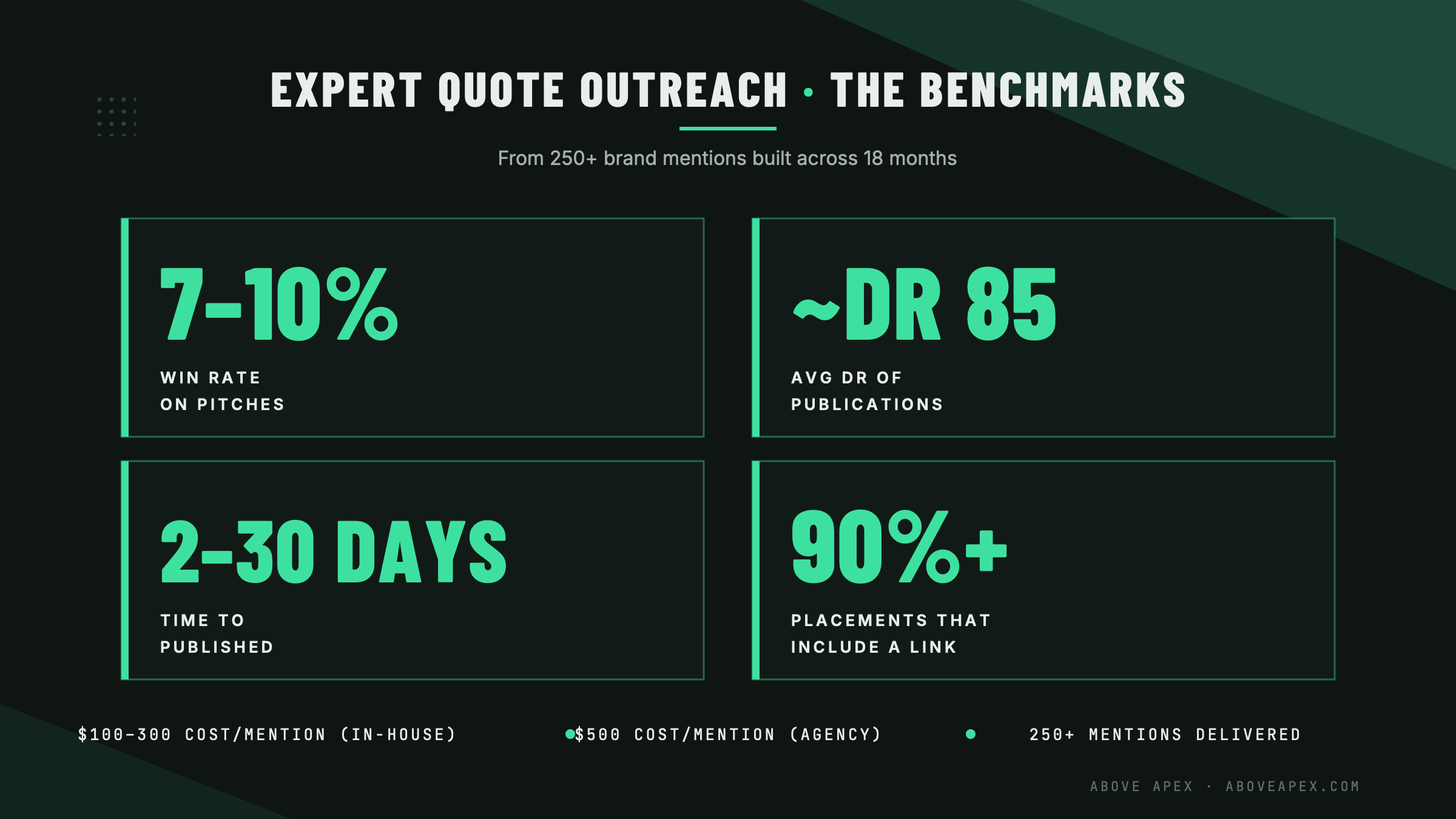
Win rate: 7–10 published mentions per 100 pitches. That’s on the high end for the channel. Most teams running this badly see 1–3%. The difference is profile quality, pitch discipline, and daily volume.
Average DR of publications: ~85. These are real editorial publications that rank for the queries your buyers are running – not scraped blogs or guest post farms. Over the past 18 months we’ve placed clients in HubSpot, Zapier, Fast Company, GoDaddy, Shopify, Hootsuite, Yahoo, AOL, Semrush, Muse, and many more in the DR 80–96 range.
Link inclusion: 90%+ of placements include a link. Unlinked-only mentions do happen, and some outlets default to nofollow, but the majority of wins carry a dofollow link back to the client.
Time to published mention: 2 weeks to 30+ days. Even when a journalist accepts your pitch on day one, the article may not publish for a month. Editorial calendars aren’t negotiable. Plan around this – don’t try to compress it.
Cost per mention: $100–$300 if you run the process in-house (your only hard cost is platform subscriptions and the internal time to pitch). $500 average per link if you work with a specialized agency.
The compounding effect nobody mentions
This is the part most teams miss, and it’s why so many brand mention programs get abandoned too early.
Month one, you might land 3–5 mentions. Month three, you’re landing 12–15. By month six, you’re consistently in the 20+ range per month, and the publications have gotten better – because the more recent mentions get picked up by search, fed into the AI layer, and raise your perceived authority, which makes journalists more likely to quote you in the next round.
If you quit at month two because the numbers look small, you miss the curve entirely. If you stick through month six, expert quote outreach becomes a flywheel that funds itself – and the marginal cost per mention drops because your brand is now in the Rolodex of dozens of active journalists.
Engine 2: Listicle placements
Listicles – “Top 10 X Software,” “Best Y Tools for Z” – are the second major engine we run. They rank for the highest-intent commercial queries in every SaaS category. They feed AI Overviews directly. And they put your brand in the consideration set at the exact moment a prospect is shortlisting.
We run a four-step system for listicle placements.
Step 1: Build the prospect list
Using Ahrefs and a Google scraper (Instant Data Scraper + the Google 100 Results extension), we pull the top 100 results for 3–5 query variants relevant to the client’s category.
For a data privacy platform, that looks like: “best data privacy software,” “top data privacy tools,” “best enterprise privacy platforms,” “privacy management software comparison,” “top consent management platforms.”
De-dupe the combined list. What you’re left with is every article that already covers this category and doesn’t yet include your client.
Step 2: Prioritize by metrics
Run the URL list through Ahrefs Batch Analysis. Pull Total Traffic and Domain Rating for each page. Our baseline filters:
- Remove any page with less than 2,000 monthly organic traffic
- Remove any domain with DR below 45
Everything below those thresholds is noise. What’s left is the high-value target list – pages that actually have the authority and traffic to matter.
Step 3: Prioritize by relevancy
Metrics alone aren’t enough. Inside the filtered list, you still need to rank by how relevant each listicle is to the specific solution you’re selling.
A “Best Enterprise Video Editing Tools” listicle matters more than a generic “Best Video Tools” roundup if your client sells to enterprise. A “Best B2B Subscription Management Software” listicle matters more than a generic SaaS roundup if your client is a subscription management tool.
Your top 20–30 most relevant, highest-metric listicles become your priority outreach list.
Step 4: Outreach with the right incentive
For each target, scrape the author and decision-maker contacts using Phantom Buster + LinkedIn’s Company Employee scraper + Prospeo (or a similar email finder). Verify emails. Then run a 3-email outreach sequence through Smartlead, Instantly, or Mailshake.
The outreach positions your client as a natural fit for the list and offers value in exchange for inclusion. The incentives that work, in rough order of effectiveness:
- A free trial or freemium access for the author to test the product
- A guest quote or expert commentary from the client’s executive team that adds editorial value to the article
- Sharing the updated article across the client’s channels (email list, LinkedIn, Twitter)
- Link exchange – direct or three-way, depending on what’s acceptable
- Coupon codes or vouchers the author can offer their readers
- Payment for inclusion, where the publication accepts it (be transparent about this)
Not every listicle will accept every incentive. The best operators match the incentive to the publication – a major editorial site won’t take payment but might take a strong expert quote; a smaller niche blog might value a link exchange more than anything else.
Case in point: Younium
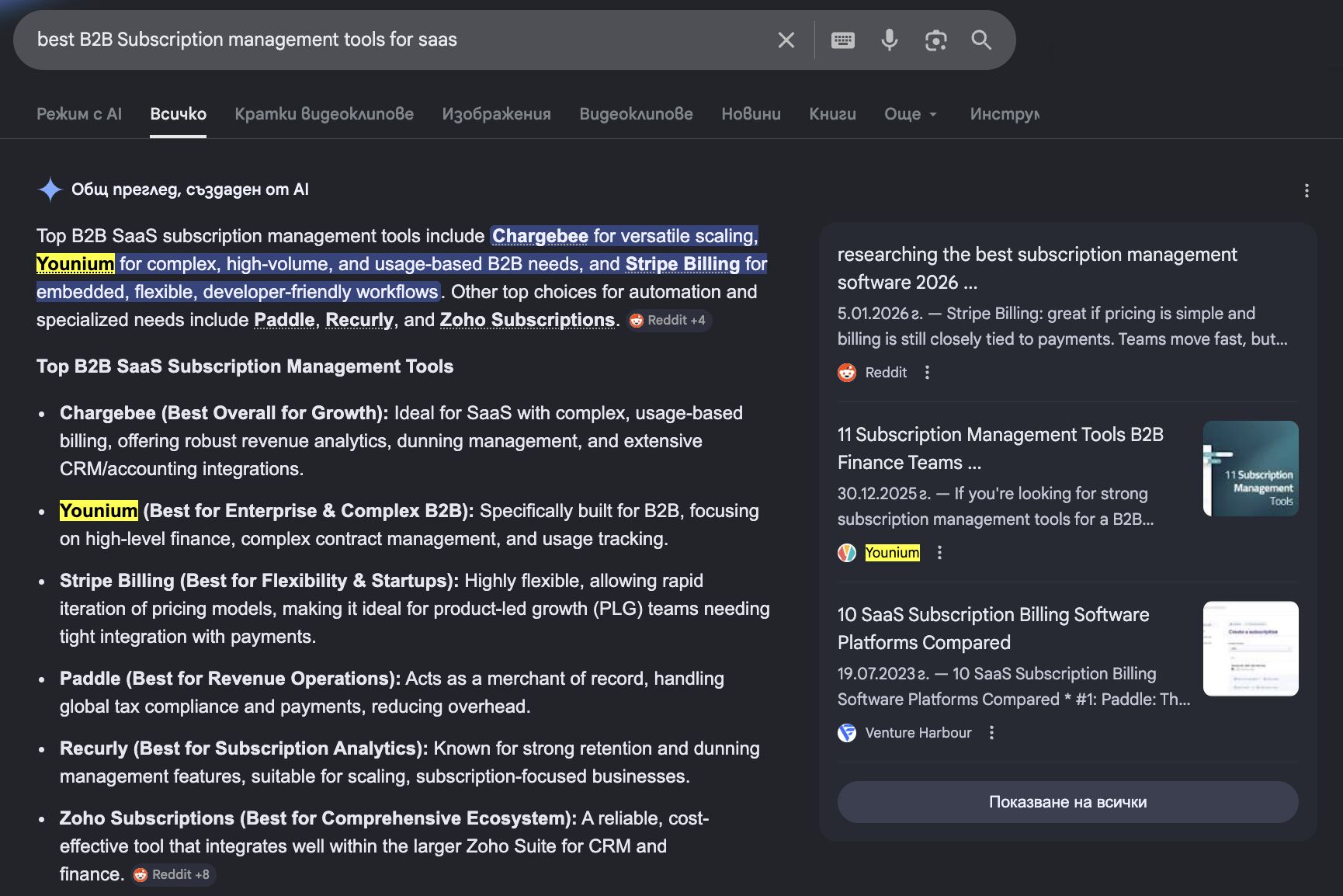
We ran this system for Younium, a B2B subscription management platform. Inside 60–70 days, we placed them in 15 relevant listicles targeting their core category.
Within weeks of those placements hitting and getting indexed, Younium started showing up as a cited option in AI Overviews and LLM answers for “B2B subscription management software” and related queries. The listicles fed the AI layer, and the AI layer fed their inbound pipeline.
Listicle placements, done at this velocity and on the right targets, are the fastest path to AI citations in any SaaS category.
Engine 3: Podcast outreach
Podcasts are the most under-leveraged brand mention channel in B2B SaaS. The conventional view treats them as “content marketing” — you go on a show, have a conversation, maybe get a few new listeners. That view misses the point entirely.
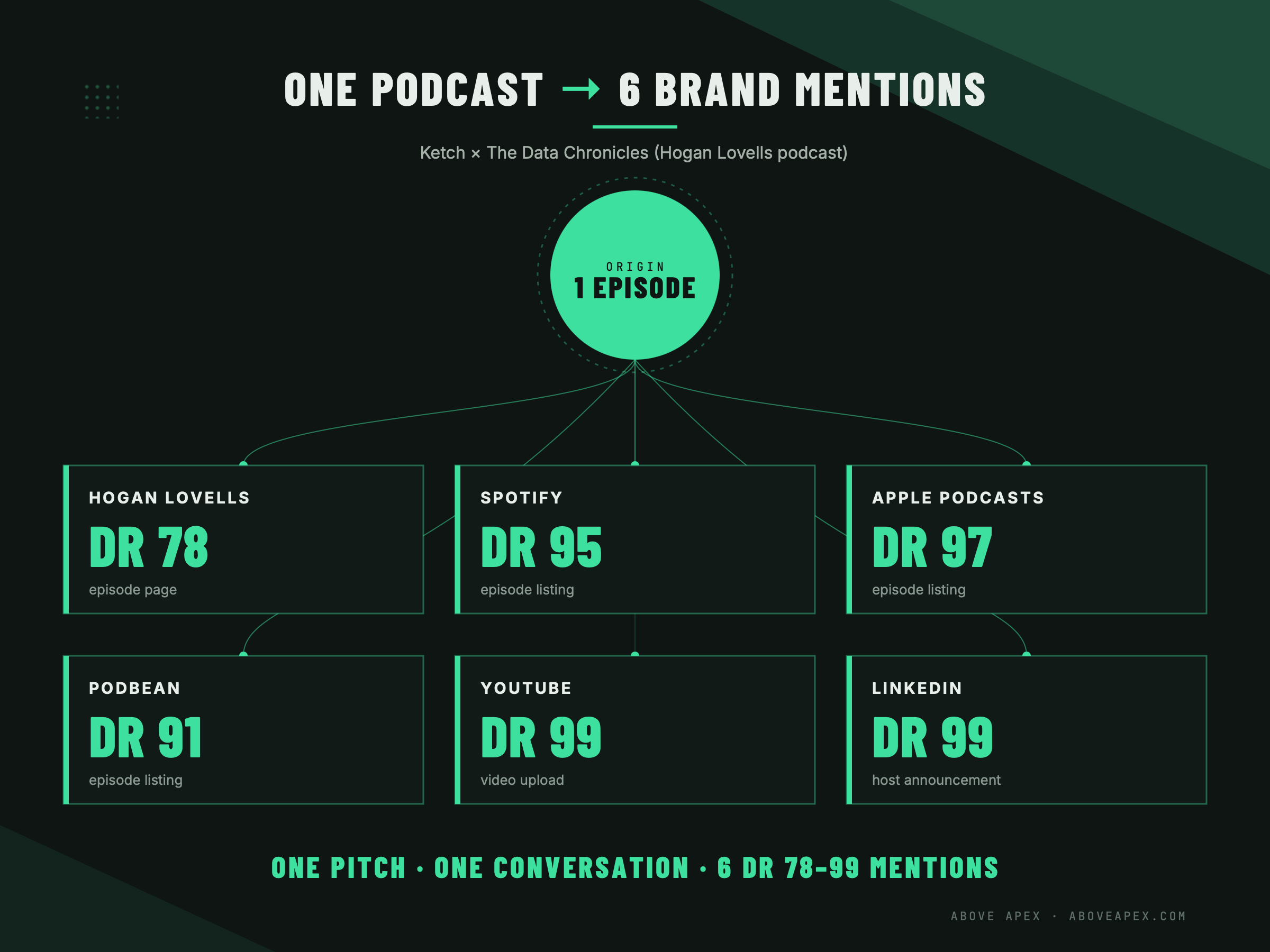
A single podcast appearance generates brand mentions across 5–6 independent high-authority surfaces. Here’s what one Ketch appearance on The Data Chronicles (the Hogan Lovells podcast) actually produced:
- The episode page on the Hogan Lovells site – DR 78
- Spotify episode listing – DR 95
- Apple Podcasts listing – DR 97
- Podbean listing – DR 91
- YouTube video – DR 99
- LinkedIn announcement post from the host – DR 99
One pitch. One conversation. Six brand mentions on DR 78–99 surfaces – plus the ongoing discovery as the episode keeps getting indexed across podcast search, YouTube recommendations, and social reshares.
This is the distribution leverage no other channel gives you. Expert quotes get you one mention per win. Listicles get you one listing per placement. Podcasts syndicate a single appearance across every major audio, video, and social surface automatically – and they keep delivering mentions for months after the record date as the episode is re-shared, clipped, and referenced.
How to run podcast outreach
The process:
- Build a target list of 30–50 podcasts in your category. Use Listen Notes, Podchaser, or manual research. Filter for shows with real production quality, a consistent publishing cadence, and an audience that matches your ICP. Skip dead shows – podcasts that haven’t published in 90+ days are a waste of pitches.
- Prioritize shows with strong multi-surface distribution. Look for podcasts that publish to Spotify, Apple Podcasts, YouTube, and have an active LinkedIn presence for the host. That combination is what delivers the 5–6x compounding effect. A show that only publishes to one surface isn’t worth the same effort.
- Pitch a specific episode angle, not your bio. Podcast hosts get dozens of generic “my CEO would be a great guest” pitches per week. The pitches that land propose a concrete topic, reference a recent episode the host published, and explain specifically what makes your expert the right guest for that conversation.
- Record at least 3–5 shows per quarter. One appearance is a data point; a sustained cadence compounds. After six months of consistent podcasting, your expert becomes a recognized voice in the category – which raises win rates on every other channel simultaneously.
Three tactical notes from running this for clients: First, always confirm with the host whether they’ll post a LinkedIn announcement (most do; some don’t – this single surface is often the highest-authority mention from the entire syndication). Second, send them a ready-to-use intro blurb and headshot in advance – it makes it effortless for them to post the announcement correctly and improves your chances of being tagged. Third, always offer to cross-promote the episode on your own channels. Hosts prioritize bookings with guests who drive listens.
Podcast outreach takes more effort per pitch than expert quote outreach, but the output multiplier is 5–6x per appearance. For client programs, we run all three engines – expert quotes, listicles, podcasts – in parallel, because they hit different surfaces and different stages of the buyer journey.
Converting unlinked mentions into backlinks
Not every mention of your brand online includes a hyperlink. Some publications – enterprise news sites, certain trade magazines, some editorial outlets – frequently mention brands without linking out, either by policy or oversight. These unlinked mentions are still valuable on their own, but you can extract more from them by systematically converting a portion into backlinks.
The process:
- Find the unlinked mentions. Use Ahrefs Content Explorer, Google Alerts, or a dedicated tool like Mention or Brand24. Search your exact brand name in quotes and filter for pages that mention you without linking to you. Do this monthly.
- Qualify the list. Prioritize mentions on DR 40+ domains with real organic traffic. Skip scraper sites, aggregators, and low-quality reproductions – they’re not worth the outreach time.
- Reach out to the author directly. Not the generic editor inbox – the specific writer who published the article. Keep the email short and friendly. Thank them for the mention, then ask if they’d be open to linking to your homepage or a relevant resource. Make it easy: give them the exact anchor text and URL you’d like.
- Expect a 15–30% conversion rate on well-qualified reclamation outreach. It’s one of the highest-ROI link building activities most teams aren’t running consistently.
Reclaim 10 unlinked mentions per month and you’re adding 120+ editorial backlinks per year from publications that already find your brand credible enough to reference – often at DR 70+.
What makes brand mentions actually work (the client-side prerequisites)
Here’s something most agencies won’t say out loud: brand mention campaigns underperform when the client side isn’t set up right. The outreach can be executed perfectly and the results will still be soft.
The variables that matter most:
Developed LinkedIn profiles for your quotable experts. Journalists check. If your CEO has a 200-follower profile with no posts in two years, your pitch is harder to place – even if the answer is good. Executives with real activity, thought leadership posts, and visible expertise consistently land more mentions. If your founder’s profile is weak, spend 60 days fixing it before you scale outreach. The ROI is real.
A clear POV on category topics. Your expert needs opinions, not neutral summaries. Journalists want sharp quotes, not “well, it depends.” Before you run outreach at volume, spend a month internally sharpening the take your experts will repeatedly deploy on category questions.
Multiple voices. One CEO can carry a small program. For serious volume and topical breadth, you need 2–3 voices across different functions – CEO, CTO, CMO, Head of Product, Head of Customer Success. Match the voice to the query.
Response speed. When a journalist posts a query with a same-day deadline and you respond within the hour with something quotable, you land the mention. Build an internal SLA that gets expert quote responses out within 4–6 hours during business days. This single operational detail separates winning programs from losing ones.
The tool stack we actually use
No affiliate spin, no sponsored picks – this is the stack we run internally:
Prospecting: Ahrefs for traffic, DR filtering, and competitor backlink analysis. Manual research for the edge cases where tools miss relevant targets.
Outreach: Smartlead for cold email sequences, Dripify for LinkedIn outreach. We run both channels in parallel for listicle outreach.
Expert quote platforms: Featured, Qwoted, Help a B2B Writer, SourceBottle, Terkel. Each has a different editor and publication pool, so we cover all of them.
List building and scraping: Instant Data Scraper and/or Phantombuster + the Google 100 Results extension for the initial prospect pull. Phantom Buster + LinkedIn for decision-maker identification. Prospeo for email discovery and verification.
Tracking and reporting: Ahrefs for backlink tracking and AI citation monitoring through its Brand Radar feature. We also spot-check Google AI Overviews and ChatGPT/Perplexity manually for client-critical queries every week or two. Recently we have been heavily focusing on Peec AI as well.
This is a lean stack. Most of the value comes from operator discipline on top of the tools, not from tool sprawl.
How to measure whether brand mentions are working
These are the metrics that actually matter, in order:
Keyword rankings on your target commercial queries. This is the core SEO outcome. You should see movement first on queries that have a lot of listicle/editorial coverage – these are the queries most directly influenced by brand mention work. If you’re ranked #9 on “best [category] software” and there’s sustained listicle and editorial coverage going in, you should expect to climb.
Organic traffic lift. Brand mention programs take 3–6 months to move the traffic needle meaningfully. Anyone promising faster is either getting lucky or spinning results. When the lift comes, it tends to be large and durable – Improvado’s +78K monthly organic visits, Action1’s +49.7K – because it’s driven by ranking improvements on commercial queries with real volume.
AI Overview citation count. Use Ahrefs Brand Radar or manual checks across 10–20 priority queries. Track how many Google AI Overview responses in your category cite your brand. This is the clearest AI-era leading indicator – it moves before traffic does.
LLM citations. Same discipline for ChatGPT, Perplexity, and Google AI Mode. For your 10–20 most important commercial queries, check monthly whether your brand appears in the answer, and whether it’s described accurately.
Brand share of voice. What percentage of the relevant editorial surface mentions you vs. the top competitors? Even a rough manual score is useful – “we appear in 8 of the top 30 listicles; OneTrust appears in 27; we have 18 gaps to close.”
What to ignore: raw mention volume without context. The number of mentions doesn’t matter if they’re on sites nobody reads and no AI model is trained on. What matters is whether mentions are on the surfaces where your buyers and the AI layer actually look.
The mistakes we see constantly
Chasing only DR 80+ links and ignoring everything else. The entity coverage framework says you need breadth. A DR 55 listicle that ranks for a high-intent commercial query will often drive more pipeline – and more AI citation impact – than a DR 90 press release that nobody reads and no LLM indexes.
Quitting at month two or three. Brand mentions compound. If you quit before the flywheel kicks in, you’re paying for the investment and walking away before the payoff. The brands we see win this channel are the ones who commit for at least 6 months, ideally 12.
Weak expert profiles. Running outreach with an executive who has a neglected LinkedIn, no public POV, and a 4-year-old headshot. Fix the profile first. The delta in placement rate is dramatic.
Treating brand mentions as a separate channel from content and on-page SEO. They’re not separate. Content makes you findable. On-page SEO gives the AI layer something clean to cite. Brand mentions make you credible. All three compound on each other; none of them works well in isolation.
Ignoring unlinked and implied mentions. Not every mention needs a hyperlink to count. Google and LLMs reason about entities and co-occurrence, not just link graphs. A prominent unlinked mention in a trusted publication still moves the needle on your entity signal.
Obsessing over metrics in the first 60 days. The noise-to-signal ratio in the first two months is high. Trust the process, stay disciplined, and evaluate at month 4–6 when the data is actually meaningful.
The short version
Brand mentions in 2026 aren’t a link building tactic. They’re the mechanism by which your brand becomes visible to the AI layer that increasingly answers questions on behalf of your buyers. Google AI Overviews, ChatGPT, Perplexity, and Google AI Mode all pull from the same pool of trusted sources – and if your brand isn’t in that pool, you don’t exist in the answer.
The brands winning this aren’t the ones with the biggest teams or PR budgets. They’re the ones running systematic off-page coverage – expert quotes, listicle placements, podcast appearances, editorial mentions, and review presence – built across every surface their category’s top players appear on.
Ketch did this against OneTrust, BigID, and TrustArc. Improvado and Action1 did this in crowded SaaS categories and added 50K–80K monthly organic visits plus hundreds of AI citations each. Younium did this in 60 days and started showing up in AI Overviews for their core category.
The playbook works. It’s repeatable. And it’s the single highest-leverage thing most SaaS brands aren’t doing yet.
Want this done for you?
At Above Apex, we run brand mention programs for brands end-to-end. That includes expert quote outreach through HARO-style platforms , listicle placements across your category’s highest-value editorial surface, podcast outreach engineered for multi-surface syndication, and full off-page coverage designed for the AI era.
If you want to see whether your category is ready for this – and what the coverage gap between your brand and the incumbents actually looks like – book a call here. We’ll map your gap and show you where the first 50 mentions should go.
FAQ
How long until brand mentions move SEO rankings?
Expect the first ranking movements around month 3, meaningful traffic lift around month 4–6, and the AI citation flywheel from month 2 onward. Programs that get abandoned before month 4 almost never see the compounding effect.
What’s the difference between brand mentions and link building?
Link building is a subset of brand mentions. Every link is a mention, but not every mention is a link. Modern SEO cares about both – links still pass authority and drive referrals; unlinked mentions still strengthen your entity signal in Google and feed the AI layer.
Do unlinked mentions actually help SEO?
Yes. Google has been capable of recognizing unlinked brand references for years, and LLMs reason about entities and co-occurrence at a much deeper level than links alone. An unlinked mention in Fast Company or Forbes still moves the needle, especially for AI citations.
How many brand mentions do I need to rank?
There’s no magic number. The right benchmark is coverage relative to your category leaders, not an absolute count. If the top 3 competitors in your category each appear in 25+ relevant listicles and 40+ editorial pieces, you need to close that gap. For most SaaS brands starting from zero, a 6–12 month program builds the floor you need.
Can I do this in-house or do I need an agency?
You can do it in-house if you have: (1) dedicated time from 2–3 expert profiles, (2) an operator who can run daily pitching and outreach, (3) the tool budget (~$500–1,000/month), and (4) the discipline to stick with it for 6+ months. If any of those are missing, an agency is usually faster and cheaper than building the muscle internally.
What’s the ROI of a brand mention program?
For the SaaS brands we’ve worked with, ROI typically comes from three stacked sources: ranking improvements on commercial keywords (organic pipeline), AI citations (a rapidly growing pipeline source), and direct referral traffic from high-authority publications. The Improvado and Action1 case studies above – each adding 50K–80K monthly organic visits – are representative of what a well-run 6–12 month program produces in a competitive SaaS category.