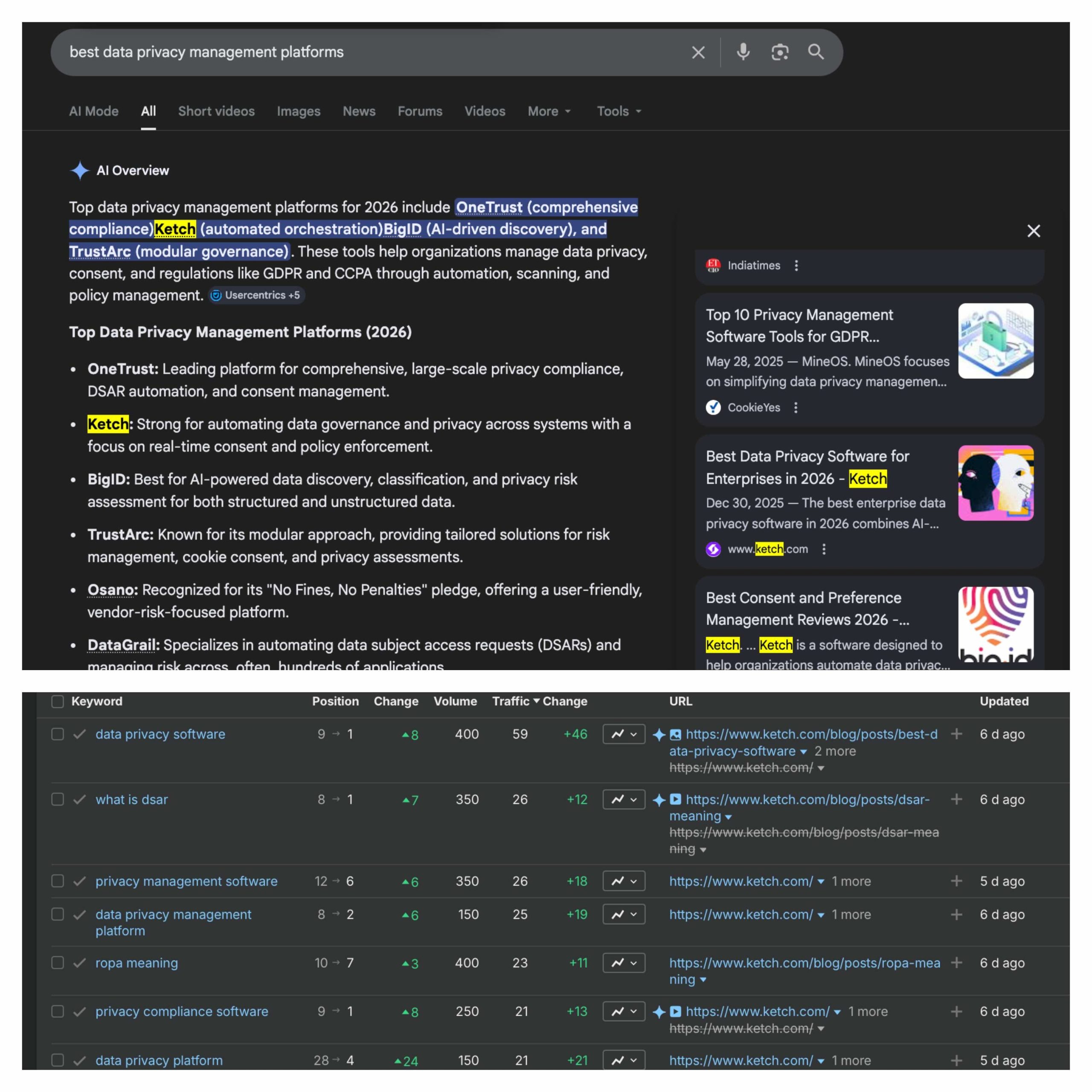
In April 2026, Google’s AI Overview for “best data privacy management platforms” returned five vendors. OneTrust was first. Ketch – a category challenger – was second. Ahead of BigID, TrustArc, and Usercentrics.
Ketch didn’t run a content overhaul to get there. They didn’t ship new schema, rewrite their homepage, or publish a thought-leadership campaign. They built systematic off-page presence in the places Google already trusted, and the AI Overview followed.
We’ve now done variations of this work for 60+ B2B brands. The pattern is consistent enough that we’d argue most “rank in AI Overviews” advice you’ll read is solving the wrong problem.
What is a Google AI Overview?
An AI Overview is an AI-generated answer that appears at the top of Google’s search results. It’s produced by Gemini, Google’s large language model, which synthesizes content from sources Google has indexed and considers trustworthy. Each overview includes citation links back to the source pages it pulled from. AI Overviews now appear on roughly a quarter of all searches, and the citations they surface are increasingly the gateway to brand visibility on Google.
Why most AI Overview advice misses the point
Open the top ten guides on this topic and you’ll find the same checklist: add FAQ schema, write semantic triples, structure content for passage extraction, optimize for query fan-out. None of it is wrong. Most of it is also irrelevant if your brand isn’t already showing up in the conversations Google reads.
AI Overviews don’t pull from thin air. They pull from sources Google already trusts – listicles, review sites, Reddit threads, YouTube transcripts, editorial publications, and pages that rank in the organic top ten. If you’re not present in those sources, no amount of on-page optimization will surface you in the answer.
The mental shift is this: AI Overview citations are a downstream effect of brand presence, not a content-formatting problem. Your page can be perfectly structured and still never get cited, because Gemini is synthesizing from the web, not from your blog in isolation.
The two levers that actually move citations
There are exactly two levers that move the needle on AI Overview visibility. Most teams pull on the second one. The first one is where the compounding lives.
Lever 1 – Off-page presence. You need to show up in every conversation about your category where your competitors already show up. Every listicle. Every Reddit thread. Every review aggregator. Every YouTube comparison. Google reads all of it and uses it to decide who belongs in the answer.
Lever 2 – Owned content built to be cited. You need pages on your own domain that rank for high-intent commercial and informational queries, structured so that the AI can extract a clean answer and attribute it to you.
Lever 1 is harder to execute and most agencies skip it because it’s not a content deliverable they can package. Lever 2 is easier to execute but useless without the brand authority that Lever 1 generates. You need both. The order matters less than the mix.
Lever 1: the “every conversation” doctrine
The first principle is simple. If your competitors are mentioned in a conversation about your category, you need to be in that conversation too. Every time.
Concretely, that means filling these gaps:
- Every listicle and roundup that ranks for “best [your category] software” or “top [category] tools”
- Every Reddit thread on the main subreddits where your category is discussed
- Every review aggregator your buyers reference – G2, Capterra, Clutch, TrustRadius, depending on category
- Every guest post, podcast, and YouTube video where your competitors have already placed
- Every guide and pillar article from major publications where multiple competitors have links and you don’t
The job is to fill the white space in your competitive landscape. The more of that space you occupy, the more your brand entity strengthens in Google’s index, and the more often you get pulled into AI-generated answers for queries in your category.
Two examples from the last 18 months.
Ketch – privacy compliance
When we started, the AI Overview for “best data privacy management platforms” surfaced OneTrust, BigID, TrustArc, and Usercentrics. Ketch wasn’t in the answer. We didn’t run an AI optimization campaign. We ran a systematic off-page program – earned links from authoritative sources, listicle placements in relevant roundups, brand mentions across media, podcasts, and tech publications.
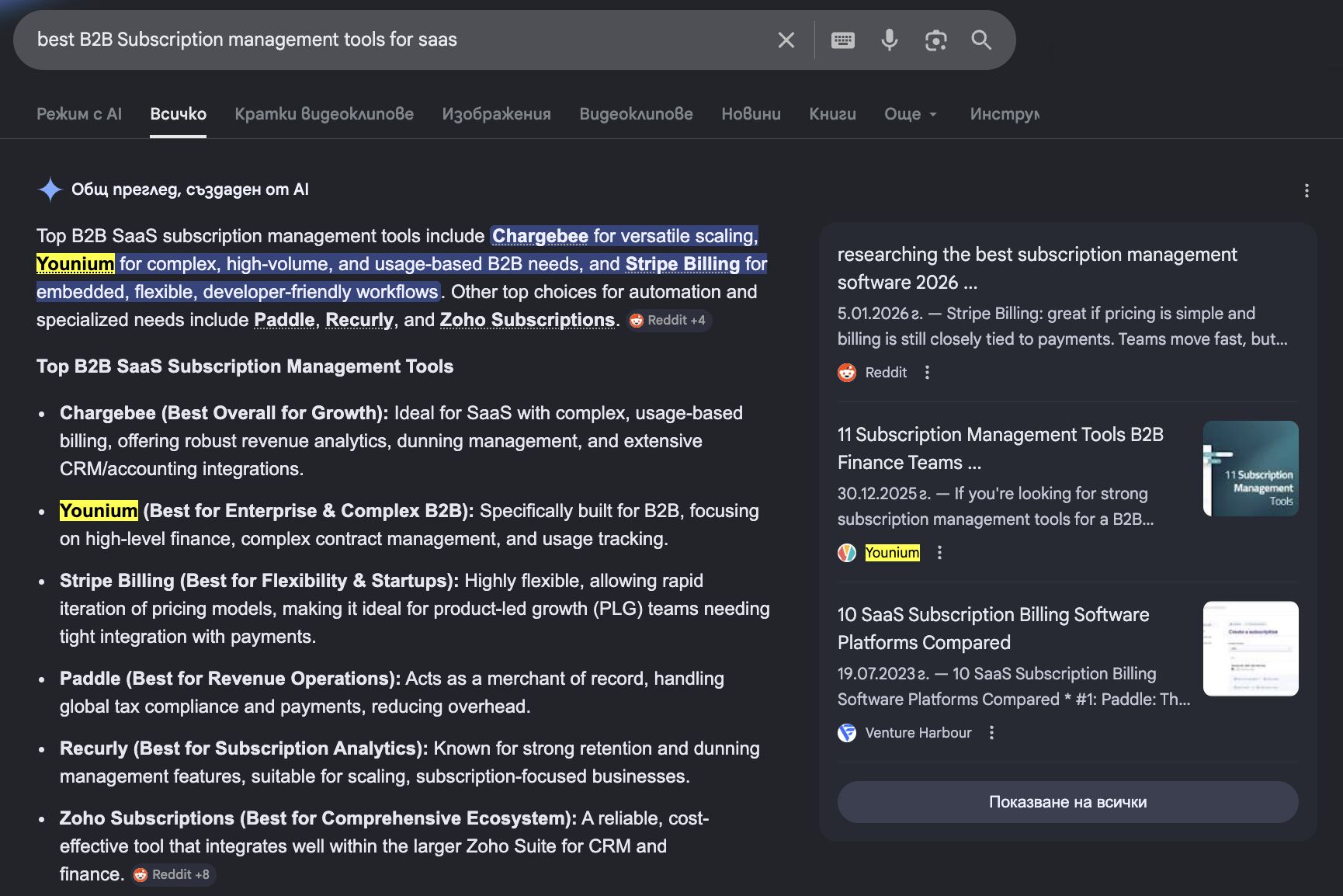
Over the next several months, organic positions on the core commercial keywords moved: “data privacy software” 9 → 1, “privacy compliance software” 9 → 1, “data privacy platform” 28 → 4. The AI Overview followed. Today Ketch sits at position 2 in that AI Overview, second only to OneTrust, with 120 AI Overview citations across the category. They aren’t optimized for AI Overviews. They have presence in the places Google trusts.
Younium – B2B subscription management
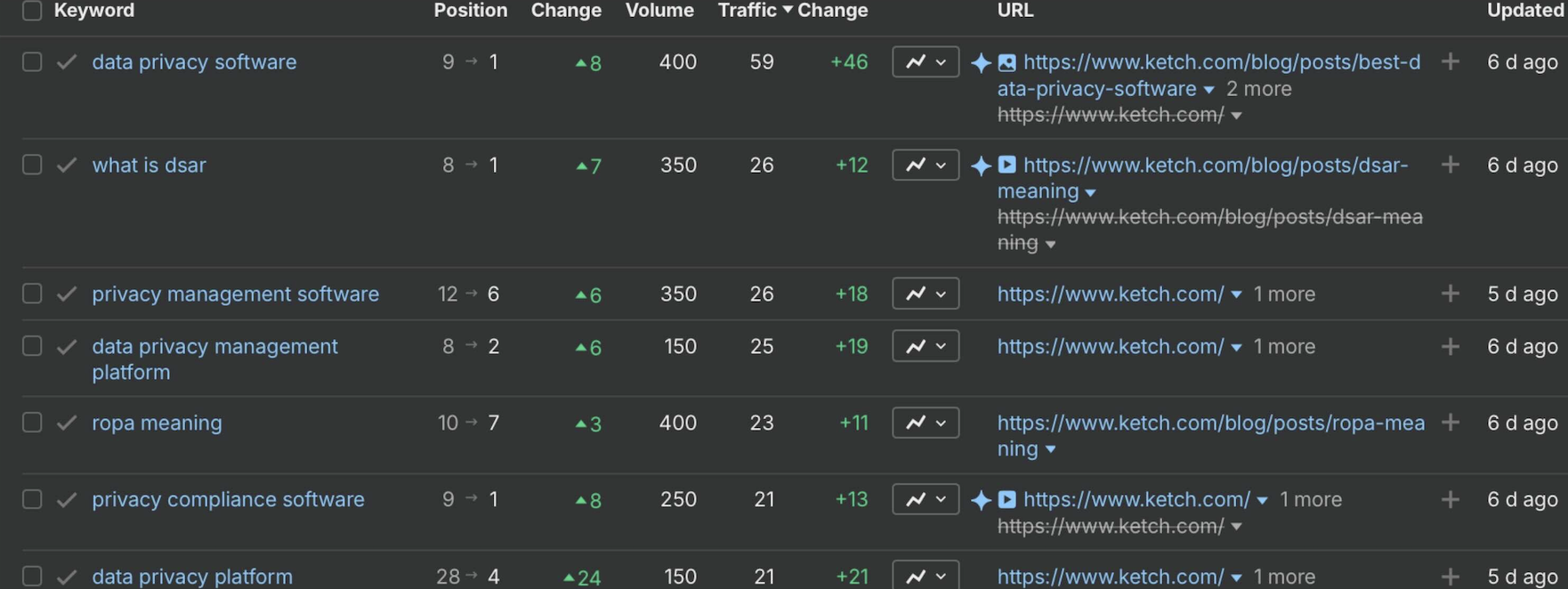
This one is closer to a controlled experiment. We placed Younium in 10–15 listicles for B2B subscription management over a focused period. No technical SEO overhaul. No content push. Nothing else changed.
Within weeks, Google’s AI Overview for “best B2B subscription management tools” started naming Younium directly – pulled out as the option for “complex, high-volume, enterprise B2B,” cited alongside Chargebee and Stripe Billing. We won’t claim 100% attribution. But the only variable that changed was off-page presence in the conversations the AI was already reading.
The compounding effect is what most teams miss. Once we started getting Above Apex itself included in listicles for SaaS link building, we started getting mentioned in the main Reddit threads where the category is discussed. We started building YouTube content in parallel. Less than a month later, the footprint of our brand in AI Overviews for relevant queries increased measurably. None of it was AI optimization. All of it was brand presence in the right places.
Lever 2: owned content that earns the citation
The second lever is content on your own domain that’s specifically built to be cited – pages that target the commercial and informational queries where AI Overviews appear, structured so that an AI model can extract a clean answer and attribute it to you.
The fastest way to build this lever is to copy from your competitors first. Take the top five queries in your category. Search each one. Look at which of your competitors are getting cited in the AI Overview. Open those pages. Find the gaps – what’s missing, what’s outdated, what’s surface-level. Then build your version better. More specific, more recent, more useful, more honest.
Two examples.
Above Apex – our own service page
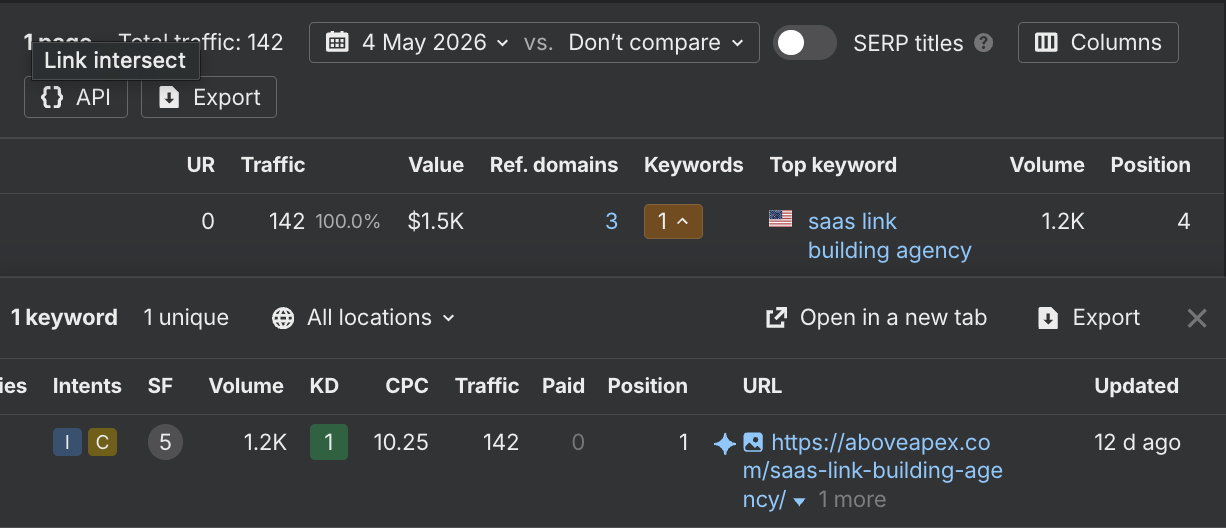
We built a service page for SaaS link building – heavy on social proof, named case studies, real numbers, named client logos, and video testimonials. No technical SEO overhaul, no schema gymnastics. Ten days after publication, the page ranked position 1 for “saas link building agency” (1.2K monthly volume, $10.25 CPC, 142 monthly visits) and was being pulled into the AI Overview for the query.
The page wasn’t engineered for AI extraction. It was engineered to be the most credible thing on the SERP – and the AI treated credibility as the signal.
Above Apex – best SaaS link building agencies
We also built a listicle on the same topic. Within a short window it started getting cited as a source in AI Overviews for the category. This is the easiest lever for any B2B team to pull: publish your own listicle for your own category, make it more useful than what’s already ranking, and the AI will read it. Done well, it accomplishes two things at once – it pulls citations toward your domain, and it gives you an editorial surface where you can frame the category on your terms.
A practical pattern that works: pillar service or category page → comparison and vs pages → listicle of best-in-category tools → definition and explainer pages for the queries one level up the funnel. Each one targets a different stage of intent. Together they cover the surface area an AI Overview pulls from.
The numbers across 60+ clients
The compounding nature of this approach shows up clearly when you look at the data over time. Two recent client outcomes:
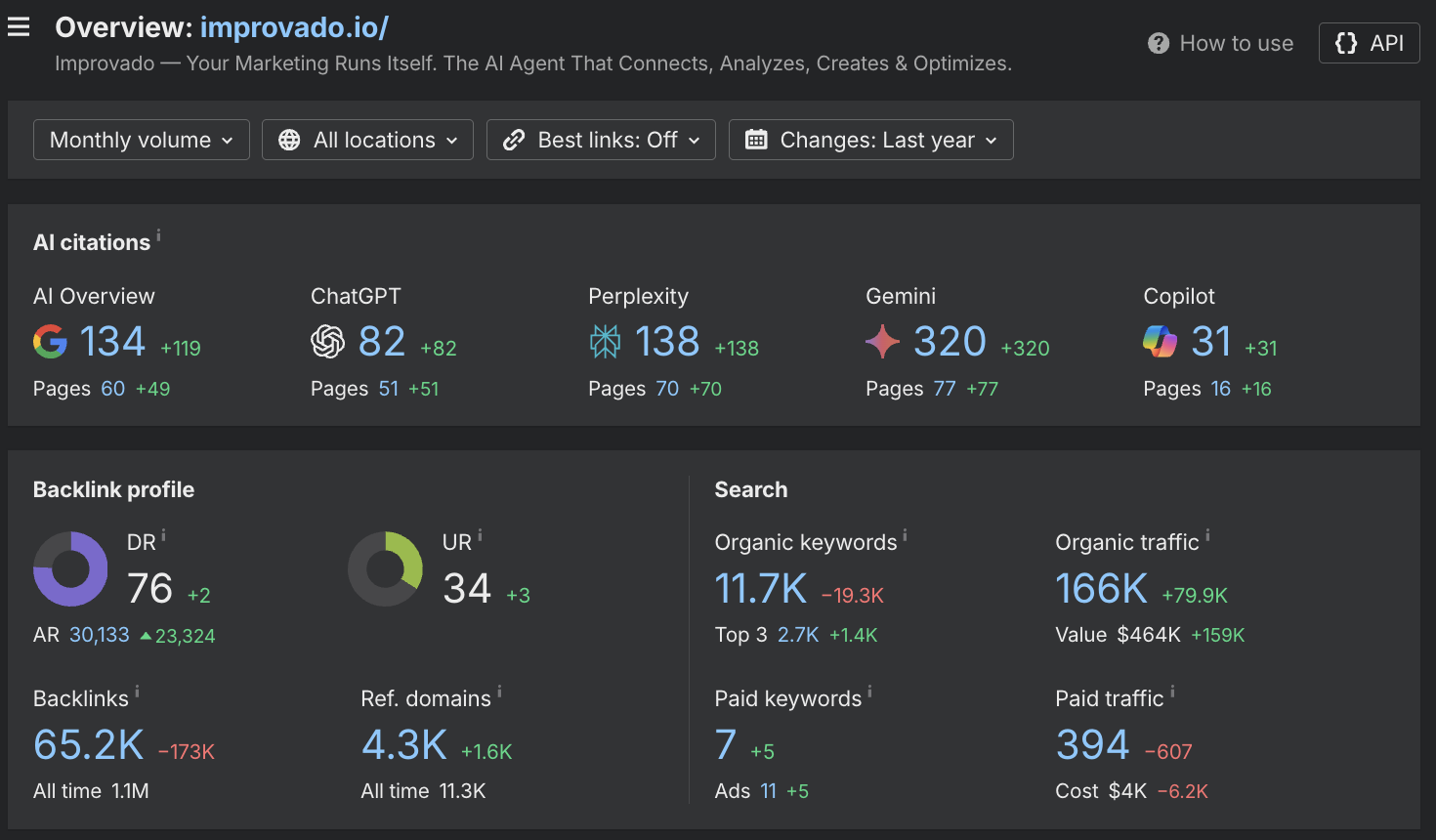
Improvado – +79,900 monthly organic visits, +119 Google AI Overview citations, +320 Gemini citations, +138 Perplexity citations, +82 ChatGPT citations, +31 Copilot citations.
Action1 – Action1 – +47,100 monthly organic visits, 315 total Google AI Overview citations, plus growing presence across Gemini, Perplexity, ChatGPT, and Copilot
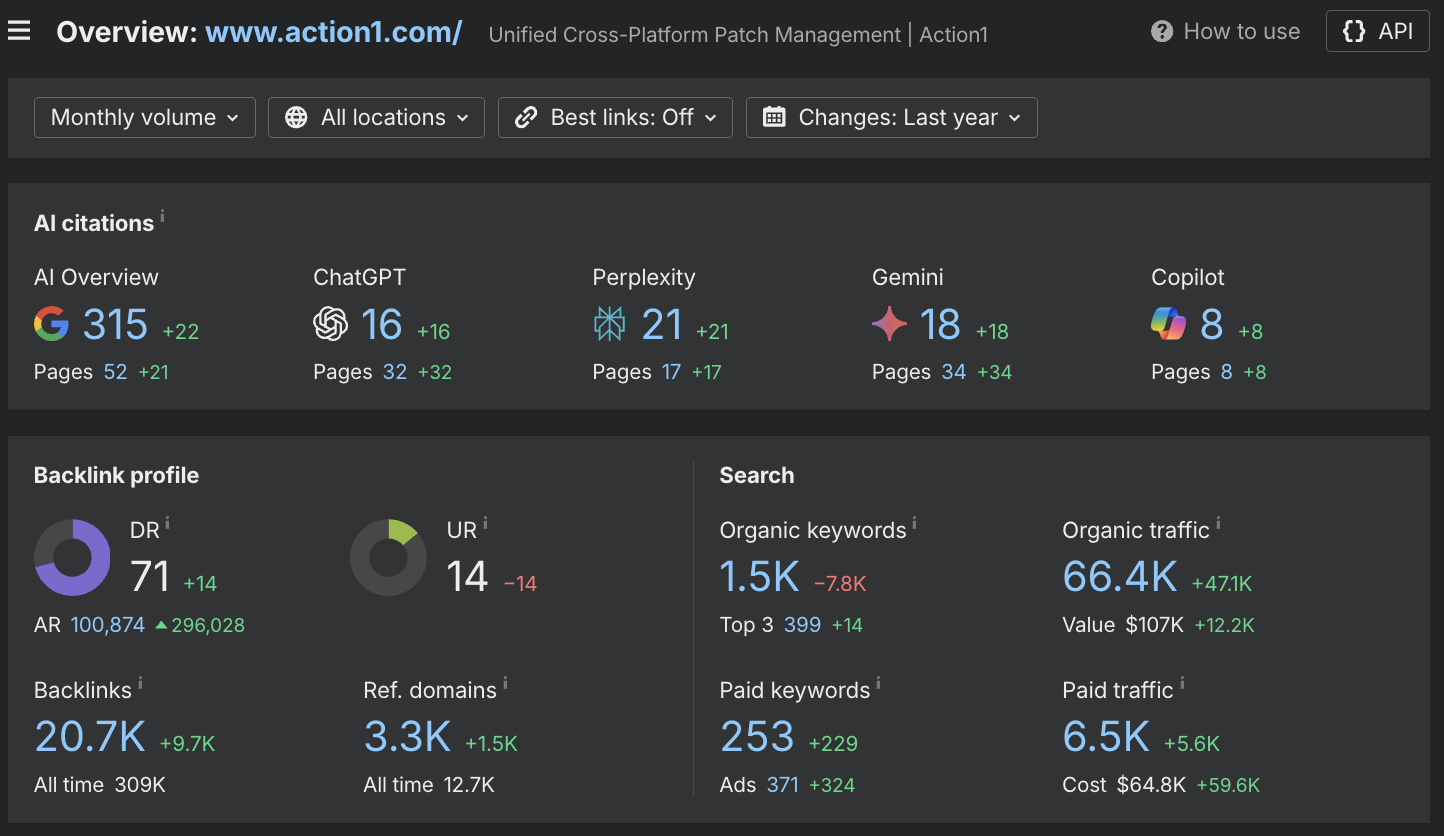
Two things stand out. First, AI Overview citations and traditional organic traffic move together. They’re not separate strategies – they’re outcomes of the same underlying brand-presence work. Second, the lift extends beyond Google. ChatGPT and Perplexity pull from substantially overlapping signals. When you build presence in the places Google trusts, you compound across every AI search interface that reads the open web.
What we don’t recommend wasting time on
A few tactics that consistently underperform for our clients, despite being recommended in most AI Overview guides:
Schema as a cure-all. FAQ, HowTo, and Article schema are useful hygiene. We add them. They have not, on their own, moved the needle for any client whose underlying issue was insufficient brand authority. Schema is a multiplier on existing trust, not a substitute for it.
AI-specific content rewrites for pages that aren’t already linked to. Reformatting your content into “answer-ready” passages with semantic triples is a real tactic, but only on pages that have the external authority to be considered a source in the first place. Optimizing extraction on a page no one is linking to is rearranging the furniture in a house no one visits.
Chasing new AI optimization tactics every month. The fundamentals – brand presence in trusted sources, owned content with real expertise, top-10 organic rankings on commercial queries – outperform every “AI Overview hack” we’ve tested. Most of those tactics work for a quarter, then Google adjusts.
A short, honest checklist
If you want to be cited in AI Overviews for your category, this is the order we’d run it in:
- List every query in your category where AI Overviews appear. Search them manually. Note which competitors are cited and which aren’t.
- Identify the off-page sources those AI Overviews are pulling from. Listicles, Reddit threads, review platforms, YouTube videos, editorial articles. Build a target list.
- Get placed in those sources systematically. Not one campaign – an ongoing program. Listicle inclusions, expert quotes, podcast appearances, review-platform presence, branded mentions in guides where competitors already appear.
- Audit the cited competitor pages. For each AI Overview where you want presence, look at the pages currently being pulled. Identify the gaps in coverage, recency, depth, or specificity.
- Build your own pages targeting the same queries. Better than what’s ranking. Specific, current, opinionated where it earns the right to be.
- Track AI Overview citations explicitly, not just rankings. Tools like SE Ranking’s AIO Research and Ahrefs Brand Radar track citation share over time. Standard organic reporting will miss most of the upside.
- Give it 60–90 days. Schema and on-page changes can move the needle in weeks. Brand-presence work compounds over months. Both are needed.
The teams that win in AI Overviews aren’t the ones running the most clever optimization campaigns. They’re the ones who already exist in the conversations the AI is reading.
If you want to see how this works in practice, our case studies cover the full numbers across Ketch, Younium, Improvado, Action1, Synthesia, Photoroom, and SimproGroup – including the off-page programs behind each result.
FAQ
How long does it take to start ranking in AI Overviews?
It can take as little as ten days to see the first signs of AI Overview citations and visibility lift. We saw that on our own site – a service page for SaaS link building was pulled into the AI Overview within ten days of publication. That’s the floor, not the average. Most clients see meaningful citation patterns build over 60 to 90 days as off-page presence compounds.
Do AI Overviews use the same ranking signals as traditional SEO?
Largely yes. Roughly 76% of cited results in AI Overviews come from pages already ranking in the organic top ten for the same query. The fundamentals that get you into the top ten are the same fundamentals that get you cited – domain authority, topical relevance, link profile, and brand presence. AI Overview optimization is not a separate discipline. It’s traditional SEO with brand-presence work weighted more heavily.
Can a small brand rank in AI Overviews against bigger competitors?
Yes. Ketch is the clearest example in this article – they got cited at position 2 in the AI Overview for “best data privacy management platforms,” ahead of BigID, TrustArc, and Usercentrics, which are larger and longer-established. Brand size matters less than execution and consistency across off-page presence, owned content, and category coverage.
Should I optimize separately for ChatGPT, Perplexity, and Google AI Overviews?
No. The fundamentals that earn citations on Google AI Overviews also earn them on ChatGPT, Perplexity, Gemini, and Copilot. All four platforms pull from substantially overlapping signals – authoritative third-party sources, well-ranked organic content, and brand mentions across the open web. If you do the work outlined in this article, the impact lands across every AI search interface that reads the public internet.
What’s the most common reason a page doesn’t get cited in AI Overviews?
Three reasons, in order of frequency: no domain authority, no brand entity, and no off-page work done. Pages that aren’t cited typically aren’t visible anywhere – they’re not in listicles, not on Reddit, not on review platforms, not on YouTube, and don’t rank in the organic top ten. The AI isn’t choosing not to cite them. It can’t find them.