Most articles about outsourcing link building are written by agencies trying to convince you to hire an agency. This one is written from the operator side, by people doing the work every week. The honest view is that most outsourcing relationships do not fail because one side is bad. They fail because the two sides never aligned in the first place. The buyer comes in with a rigid picture of what a “good link” must look like, the operator does not surface the mismatch early enough, and both sides spend six months learning the hard way. This guide is about avoiding that pattern, what good outsourcing actually looks like in 2026, and how to know when the right answer is to walk away before the engagement even begins.
Why outsourcing relationships break down
The number one reason outsourcing link building fails is misalignment, not malice. Buyers usually arrive with a fixed picture of what a successful link looks like: a specific type of site, a specific anchor format, a specific topical context. Sometimes that picture is realistic. Often it is not, because the modern outreach landscape rewards relevance and editorial context far more than it rewards rigid templates. Operators who place links every week have a current sense of what is feasible in a given niche, at a given budget, in the current quarter. Buyers who lock the strategy into a narrow box before the engagement starts cut their operator off from the parts of the opportunity space that would have actually moved the needle.
The honest answer when this kind of misalignment shows up early is for both sides to walk away. If a prospect comes in with expectations we know will not produce results, the right move is not to take the contract and hope. It is to say so directly, explain why, and let them go work with someone who is more comfortable saying yes. Forcing a relationship in those conditions is a lose-lose. Either the operator delivers exactly what was asked for and the campaign quietly fails to move metrics, or the operator pushes back constantly and the relationship turns adversarial. Neither outcome is fair to either side or healthy.
The buyers who get the most out of outsourcing tend to share one habit: they come in with a clear definition of success (which pages should rank, which keywords matter, what the commercial impact looks like) but they give the operator room to figure out the path to get there, or they determine it together. That separation, what versus how, is the single biggest predictor of whether an outsourcing engagement works.
SEO strategy is not the same as link building execution
There is a real distinction between running an SEO agency and being in the link-building work hands-on every week. Both are valuable. They are not the same competency. An SEO strategist can read the SERP, audit a backlink profile, and write a quarterly plan. A link building operator knows which sites are answering outreach this month, what kinds of pitches are converting, which placements are quietly being deindexed, and how editorial standards at major publications are tightening. That kind of knowledge has a short half-life. What worked in 2022 does not necessarily work now. What worked six months ago might not work today.
This matters when evaluating who to outsource to. An agency that consults on link building from a slide deck will give you a strategy that looks reasonable on paper. An operator who has placed twenty links this month will tell you which parts of that strategy are still feasible and which parts need to be rebuilt. Both perspectives are useful, and the choice depends on what the engagement is actually for. If it is mostly execution, you want the operator. If you already have an in-house team and you need a second opinion on direction, you want the strategist. Hiring one when you needed the other is another version of the alignment problem.
Red flags worth walking away from
The clearest signal that an outsourcing engagement is heading in a bad direction is that the operator cannot tell you in advance which kinds of sites they intend to pitch, will not share their vetting criteria, and gets defensive when asked specific questions about anchor strategy or domain quality. That posture is usually a tell.
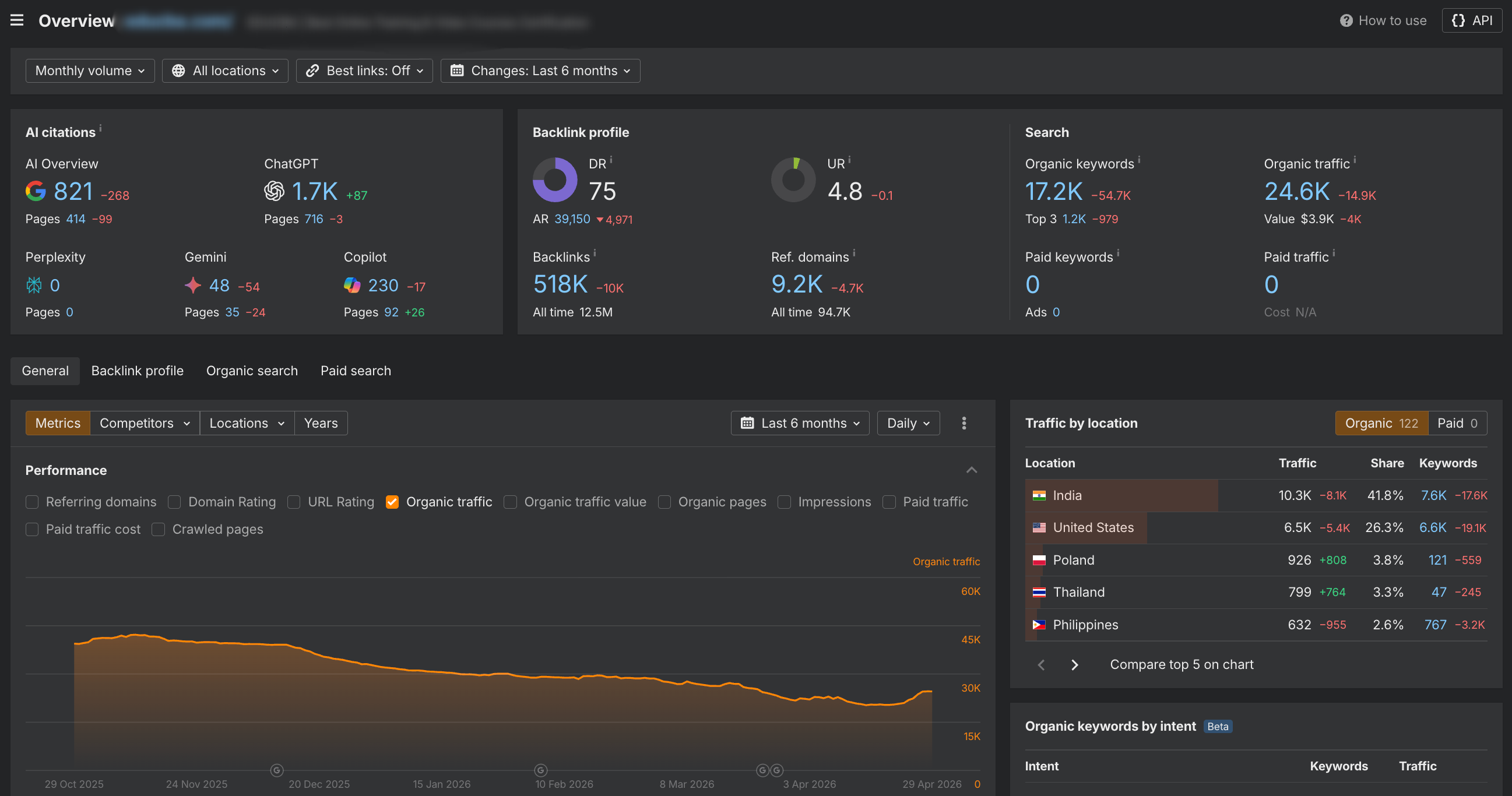
A real example. A company we had been in conversations with decided to go with an internal recommendation instead of working with us. Six months later they came back and asked for a re-evaluation of the work that had been done. The links built during that period were 2020-style PBN placements on general, off-topic sites. The traffic on the linking domains was largely from India and Pakistan, with the dominant queries being celebrity names and betting keywords. None of it had any topical relevance to the client’s business, and a significant portion of the linking domains showed signs of having been affected by Google’s spam updates. We rebuilt the foundation in a couple of days and onboarded them.
Stories like that are not unusual. The patterns to watch for, before you sign anything:
- No transparency on target domains. A real operator can show you the kinds of sites they will reach out to, with examples of past placements. Vague promises about “high authority sites” without specifics are a sign the conversation has not been concrete enough yet.
- Linking domain traffic that does not match the audience. Run a few of an operator’s past placements through Ahrefs or Semrush. Look at where the traffic actually comes from geographically and what queries it ranks for. Mismatches are obvious once you check.
- Anchor text patterns that look automated. Exact-match anchors at scale, irrelevant brand mentions, or anchor text that has nothing to do with the linking page’s topic are all signs of a templated approach that will not hold up over time.
- Volume promises that do not pencil out. Hundreds of links per month at a low per-link price almost always means something will eventually need to be cleaned up.
- No willingness to say no. An operator who agrees with every constraint you name, without pushing back on anything, is probably not going to push back on questionable placements either.
It is worth saying clearly: these are not bad-agency markers. They are misalignment markers. Sometimes the same operator who would deliver well for one client will deliver poorly for another, because the brief was wrong from the start. The work suffers either way.
What good outsourcing looks like
The starting point is alignment, not strategy. Before any outreach happens, the conversation should cover three things: which pages on your site are commercially and topically important, what authority gap exists between you and the competitors currently ranking for those queries, and what kinds of placements would actually close that gap given your footprint and budget. That conversation usually surfaces the realistic shape of the engagement quickly. If you need three links a month, your operator might be running eight or ten parallel strategies (editorial outreach, listicle inclusions, expert quotes, linkable asset promotion, partner placements) just to surface the right three opportunities. That is what efficiency looks like in practice. Volume of activity in, quality out.
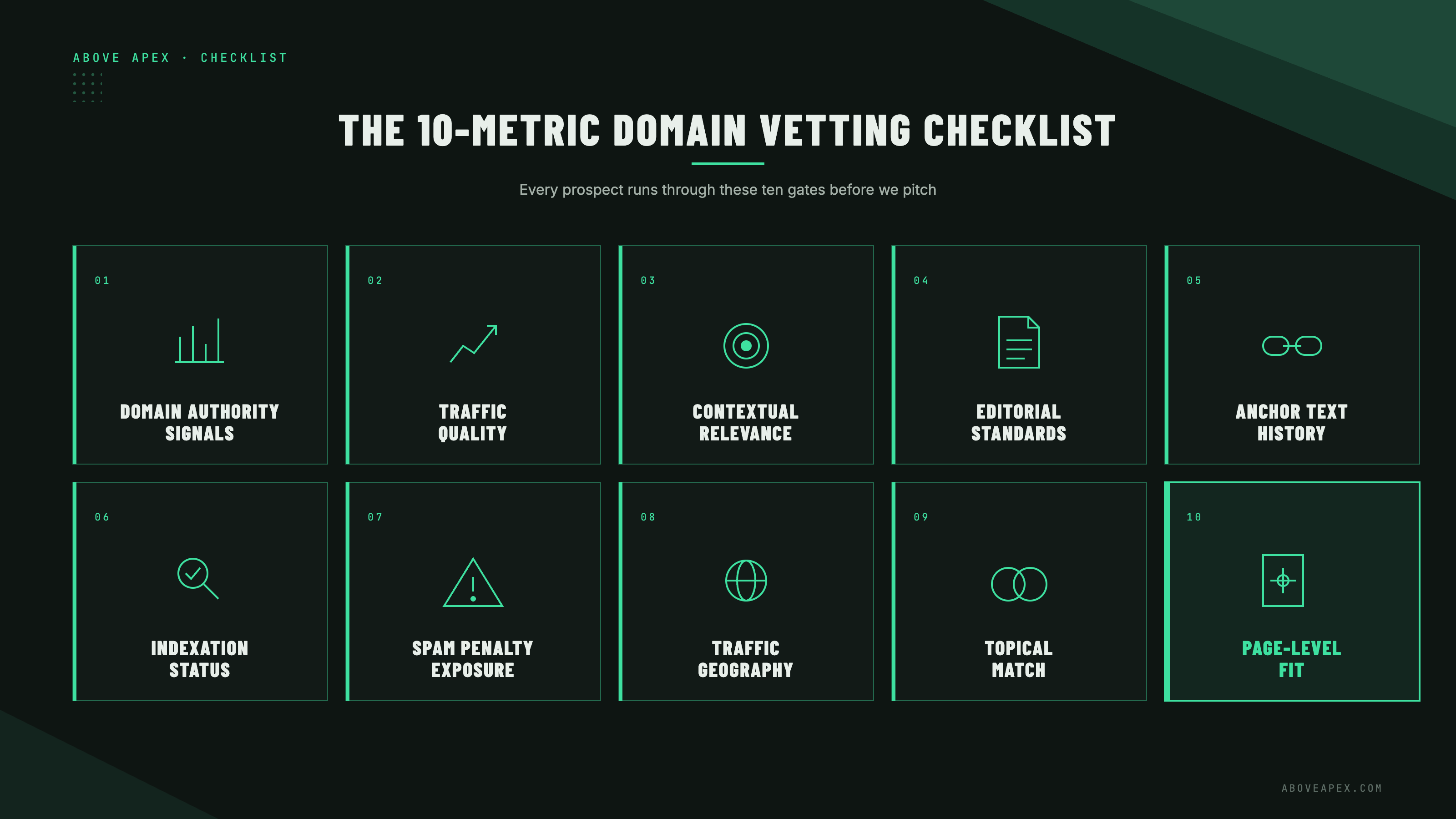
Vetting matters more than outreach volume. Every domain we evaluate goes through the same ten-metric review, regardless of whether the client is a product company, a B2B tech buyer, or a white-label agency partner. The metrics cover domain authority signals, traffic quality, contextual relevance, editorial standards, anchor text history, indexation status, spam penalty exposure, traffic geography, topical match with the client’s category, and the specific page the link would sit on. Most operators skip at least half of that. Skipping it is how the bad placements end up in the profile in the first place.
Flexibility is the other half of the equation. The need shows up most clearly with white-label agency partners, because their own clients have wildly different needs from one month to the next. One needs a guest post. One has built a linkable asset and needs promotion. One needs a listicle inclusion or a podcast appearance. An operator who can only run one tactic forces every client into the same shape, which is exactly the problem agencies tend to come to us trying to solve. The freedom to pick the right strategy for each placement, inside an agreed-on definition of success, is what makes a multi-client engagement actually work.
The KPIs that actually matter
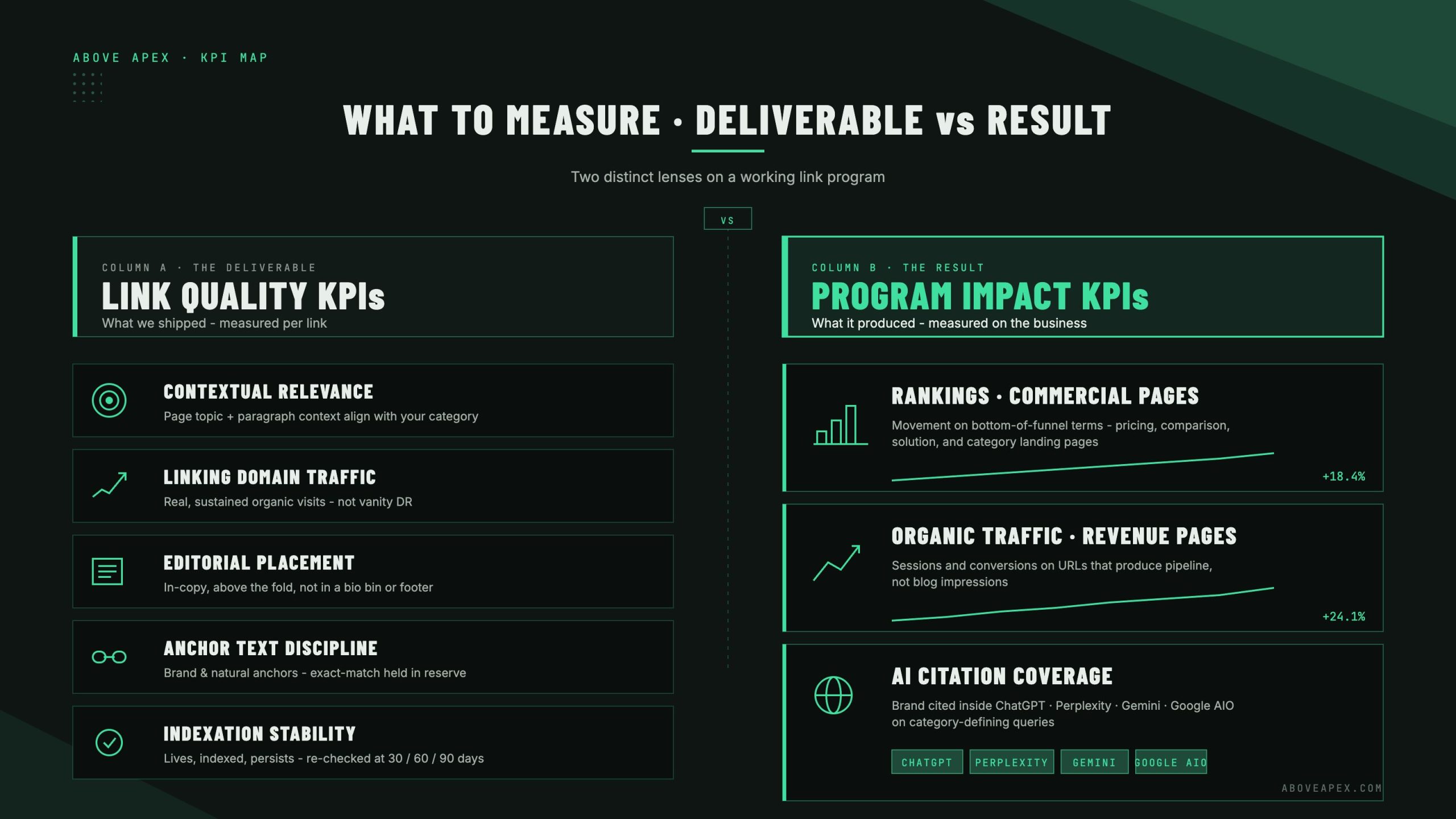
There are two layers of KPIs in a link building campaign, and most articles only talk about one.
The first layer is link quality KPIs, which measure the deliverable itself. These are the standards every individual link should be evaluated against:
- Contextual relevance to your category and to the specific page being linked.
- Real organic traffic on the linking domain, not just inflated DR or DA scores.
- Editorial nature of the placement, meaning the link was earned or pitched into the editorial content rather than paid for as a guest post package.
- Anchor text discipline that matches the natural patterns of the linking site.
- Indexation and stability of the placement over time.
The second layer is campaign impact KPIs, which measure whether the links are actually doing their job. This is where most legacy reporting falls behind.
- Rankings on commercial and TOFU/MOFU/BOFU pages. The pages that drive brand awareness, demos, trials, signups, or pipeline. If the program is not lifting those pages, the link building campaign is not working, regardless of how strong the individual links look.
- Organic traffic to those commercial pages. Same logic. Aggregate site traffic is a vanity metric. Traffic on the pages tied to revenue is not.
- AI citation coverage. This is the newer one. Links and brand mentions in editorial content increasingly feed citations in ChatGPT, Perplexity, Gemini, and Google AI Overview. In one engagement with a marketing analytics platform, the link building work produced 82 new ChatGPT citations, 328 Gemini citations (up from a low baseline), 246 Perplexity citations, and 37 Google AI Overview citations within the engagement period. Two years ago this metric did not exist. Now it is one of the clearest signals of whether your authority footprint is being recognized by the systems your buyers actually use to research solutions.
A link building campaign that hits the deliverable KPIs but never moves the impact KPIs is usually a campaign producing technically clean links pointed at the wrong pages, or pointed at the right pages without enough volume or relevance to compound. Both layers matter. Most agencies report on the first. Far fewer report on the second.
When outsourcing is the wrong move
Outsourcing link building is not the right answer for everyone. It is the wrong move if you do not yet have product-market fit, because you do not yet know which pages should rank or which keywords matter. It is the wrong move if your site has no commercial pages built yet, because you have nothing meaningful to point links at. It is the wrong move if your content motion is not running, because links amplify content; they do not replace it. And it is the wrong move if you want to micromanage every outreach email, because you will be paying senior operator pricing while restricting them to a junior level of autonomy. In any of those cases, the better answer is usually to fix the foundation first, or to bring in a strategist for a one-time engagement rather than start an ongoing campaign.
A lower-friction way to start
If you are evaluating outsourcing partners and you want to skip the standard discovery call format, send us a real situation instead. A page that is not ranking. A competitor you cannot catch. A backlink profile you want a second opinion on. We will look at it specifically and walk you through what we would actually do, including the parts where we would push back. That conversation is closer to what working together looks like than a sales call is, and it gives you the information you need to decide whether the alignment is there.
Either way, the right way to start is the same. Define what success looks like, pick a partner who is willing to tell you when your expectations need adjusting, and then give them room to do the work.