What Is AI Overview Optimization?
AI Overview optimization is the practice of structuring, sourcing, and maintaining web content so Google’s generative AI systems select it as a cited source inside an AI Overview. It is not a separate discipline from SEO – Google’s own documentation states that optimizing for generative AI search is still SEO – but it needs a different scorecard, because being cited and being ranked are measured differently.
Key takeaways:
- AI Overviews cite pages that already rank. 92.36% of AI Overviews link to at least one domain in the organic top 10, per SE Ranking’s research. Ranking is the entry ticket, not the prize.
- Commercial intent is rising fast. Keywords triggering AI Overviews went from 89% informational to 57% in twelve months (Semrush). This stopped being a top-of-funnel concern.
- Several widely recommended tactics are things Google explicitly says it doesn’t use – including llms.txt files and “chunking” content for AI.
- Schema is not a citation requirement. Google states this directly. Implement it for rich results, not because it buys AI Overview placements.
- Freshness means maintained, not new. Only 12.32% of cited sources were published within 30 days. Updated aged pages win.
- Most brand visibility in AI answers is earned off your own domain – in listicles, comparison pages, and community threads. That’s the lever most guides skip entirely.
Here’s the uncomfortable thing about this topic: if you read the ten most visible articles on it, you’ll find them contradicting each other on the numbers and contradicting Google on the tactics. So this guide does something different. Every recommendation below is sorted into three tiers – confirmed by Google, correlated in third-party studies, or unproven – and the plan at the end is built only from the first two.
How Google Actually Chooses AI Overview Sources
Before any tactic makes sense, you need the mechanism. Google has published it, and it’s short.
Retrieval, not memory
AI Overviews are grounded through retrieval-augmented generation (RAG): when a query triggers an Overview, Google’s systems retrieve relevant, up-to-date pages from the regular Search index, review what those pages actually say, and generate a response with clickable links to the pages that support it.
The practical implication is blunt: your page must be indexed and eligible for a snippet before anything else matters. No formatting trick compensates for not being retrievable.
Query fan-out: one search becomes ten
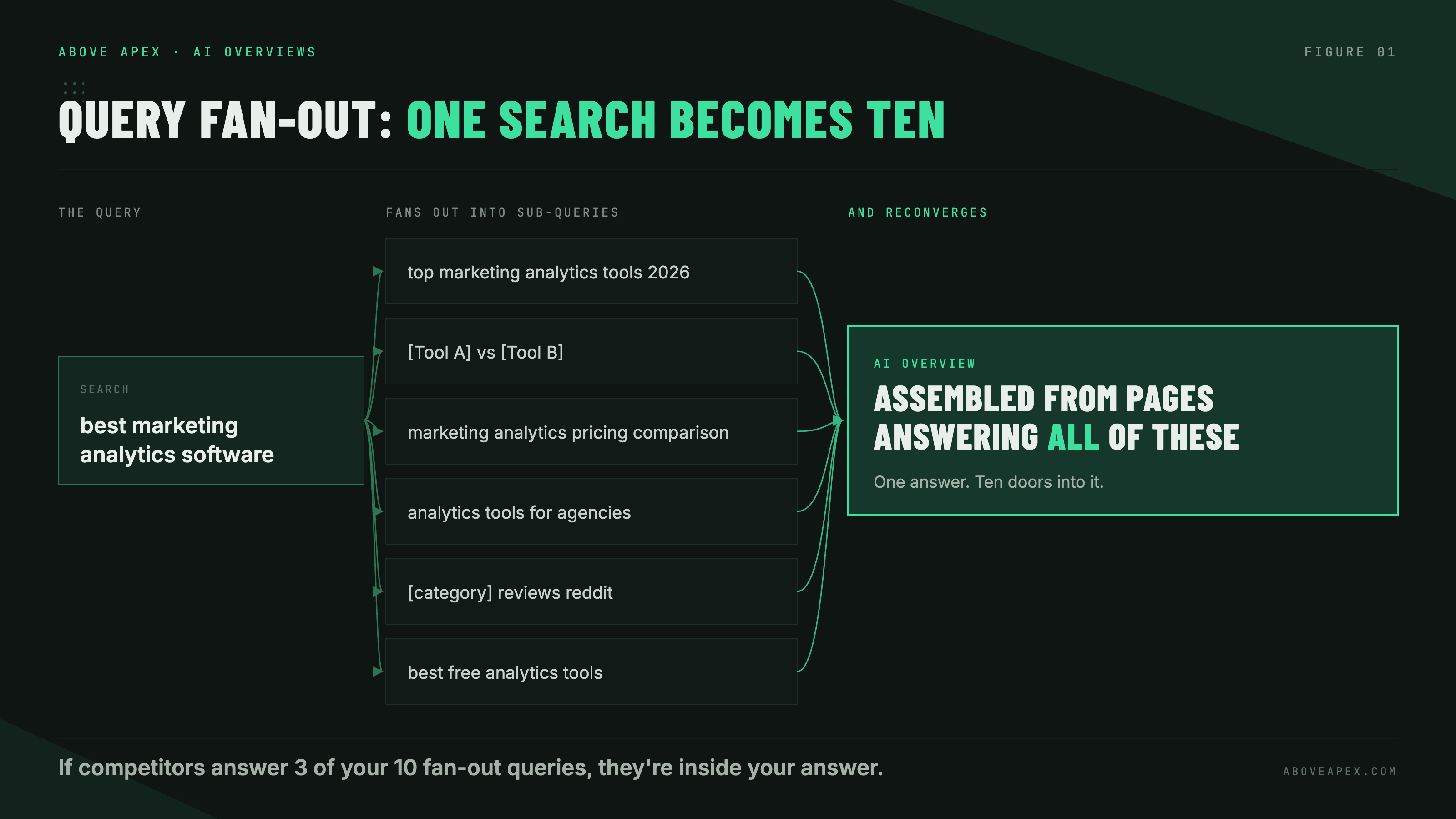
Google’s systems don’t just process the literal query. They run query fan-out – a set of concurrent related searches to fetch additional relevant results. Google’s own example: “how to fix a lawn that’s full of weeds” fans out into queries about the best herbicides, removing weeds without chemicals, and preventing weeds entirely.
Almost nobody operationalizes this, so here’s how to: take your head query, write down the 5-10 sub-questions a model would need answered to respond completely, and audit whether your page – or your site – answers each one. If three of the ten fan-out queries route to competitor content, you’re ceding parts of the answer even when you’re cited for the main one. This is the real argument for topic clusters, and it’s more precise than “cover the topic comprehensively.”
The organic ranking prerequisite
SE Ranking analyzed AI Overview citations and found that 92.36% of AI-generated answers link to at least one domain ranking in the organic top 10, and 63.19% of the time, Overviews pull from pages ranking in the organic top 10 for that query.
This is why “SEO is dead” framing gets the situation backwards. The overlap between what ranks and what gets cited is the single strongest pattern in the data. What’s changed is that ranking alone no longer guarantees the visibility – it just makes you eligible for it.
Expect volatility
AI Overviews are generated fresh, so citation presence fluctuates run to run. Research on AI search broadly (AirOps, measuring ChatGPT, Perplexity and Gemini) found only 30% of brands stay visible in an answer from one run to the next. Google’s Overviews are more stable than that – they’re anchored to the ranking index – but the same principle applies: a single check tells you almost nothing. We’ll come back to this in the measurement section, because it breaks most of the tracking advice you’ve read.
The AI Overview Numbers, Reconciled
If you’ve read five articles on this topic, you’ve seen five different figures for how often AI Overviews appear and what they do to clicks. They’re all sourced. They disagree because they measure different things at different times. Here’s the reconciliation – cite it, it took a while.
How often do AI Overviews appear?
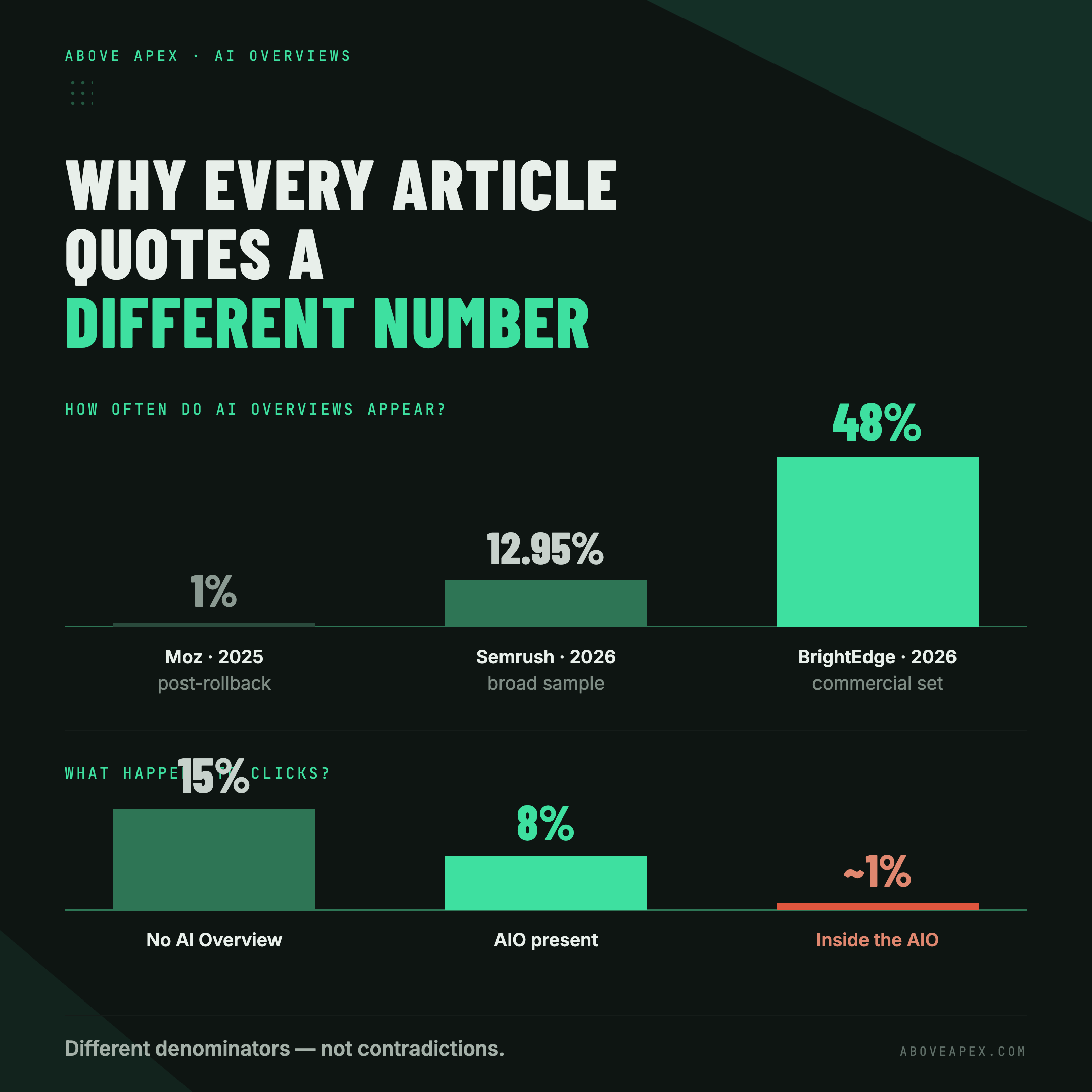
| Source | Figure | As of | What was measured |
|---|---|---|---|
| Moz / Garrett Sussman | ~1% of queries | Early 2025 | Post-rollback observation after Google pulled AI Overviews way back following the bad-press wave |
| Semrush Sensor | ~12.95% of queries | 2026 | US market, millions of tracked keywords, daily |
| BrightEdge | 48% of tracked queries | March 2026 | BrightEdge’s client-weighted keyword set, skewed toward commercial B2B/B2C terms |
The spread is mostly denominator and date. Prevalence has climbed steeply since the 2024-25 rollback, and it’s higher on commercial keyword sets than on the broad market. The number that matters is the trigger rate on your keyword list, not the market average.
What happens to clicks?
| Source | Figure | Nature of the claim |
|---|---|---|
| Pew Research Center | Users click a traditional result 8% of the time when an AI Overview is present vs. 15% when absent; links inside the Overview get clicked ~1% of the time | Observed behavior – the only methodologically transparent figure in circulation |
| Various industry estimates | CTR decline of “over 50%” | Projection, not measurement |
| Forbes (widely re-quoted) | CTR drops “as much as 70%” | Ceiling figure, routinely misquoted as an average |
Read those honestly and the story is: clicks on affected queries roughly halve, the Overview itself sends almost no traffic, and the scary 70% number is a worst case being passed around as a typical one. The consequence isn’t “traffic is dead” – it’s that presence in the answer, not the click, is becoming the KPI on informational queries, while the clicks that remain skew higher-intent.
Does freshness matter?
| Finding | Source |
|---|---|
| Citations by publication year: 28.76% from 2025, 26.85% from 2024, 11.83% from 2023 – over half from the last two years, but 7.49% from pages 10+ years old | SE Ranking |
| Only 12.32% of cited sources were published within 30 days of analysis | SE Ranking |
| Pages updated within the last three months are ~3x more likely to be cited; 70% of AI-cited pages were updated within the past year | AirOps |
These look contradictory until you notice one measures publication date and the other measures update date. The synthesis: AI Overviews favor established pages that are actively maintained – not new pages. Republishing with a fresh date does nothing. Substantively updating a trusted, aged URL is the play. (It’s also why this article displays its last-updated date at the top.)
The number almost everyone missed
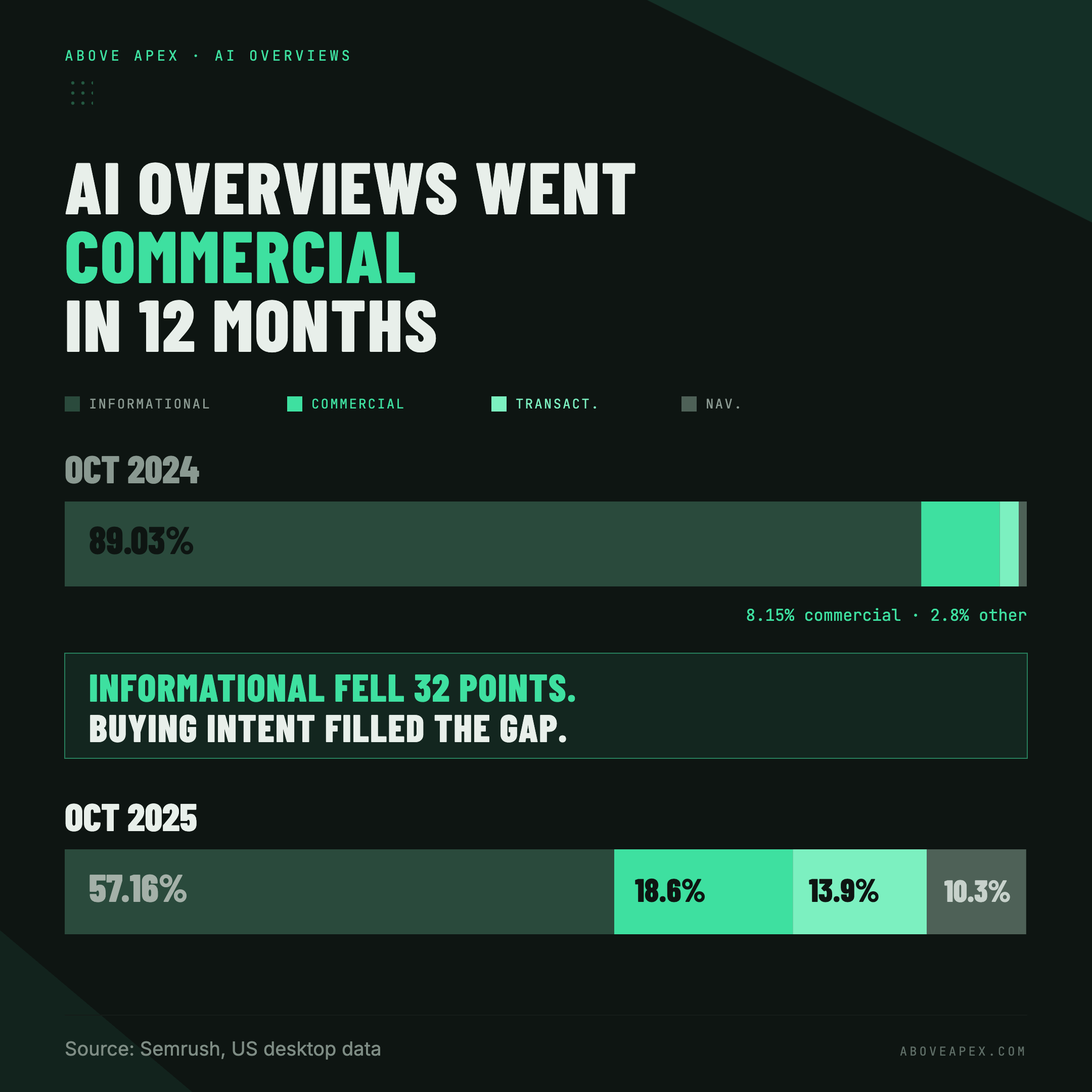
Buried in Semrush’s tracking is the most strategically important stat in this entire topic: keywords triggering AI Overviews went from 89.03% informational in October 2024 to 57.16% in October 2025, with commercial and transactional intent climbing to fill the gap.
AI Overviews started as a top-of-funnel phenomenon. They aren’t one anymore. “Best [category] software” queries increasingly return an AI-generated shortlist – and if your brand isn’t in it, your buyer’s evaluation starts without you. That’s not a traffic problem. It’s a pipeline problem.
What Works, Ranked by Evidence Strength
Most guides give you fifteen tactics of wildly uneven quality in one flat list. Here they are sorted by how much you should trust them.
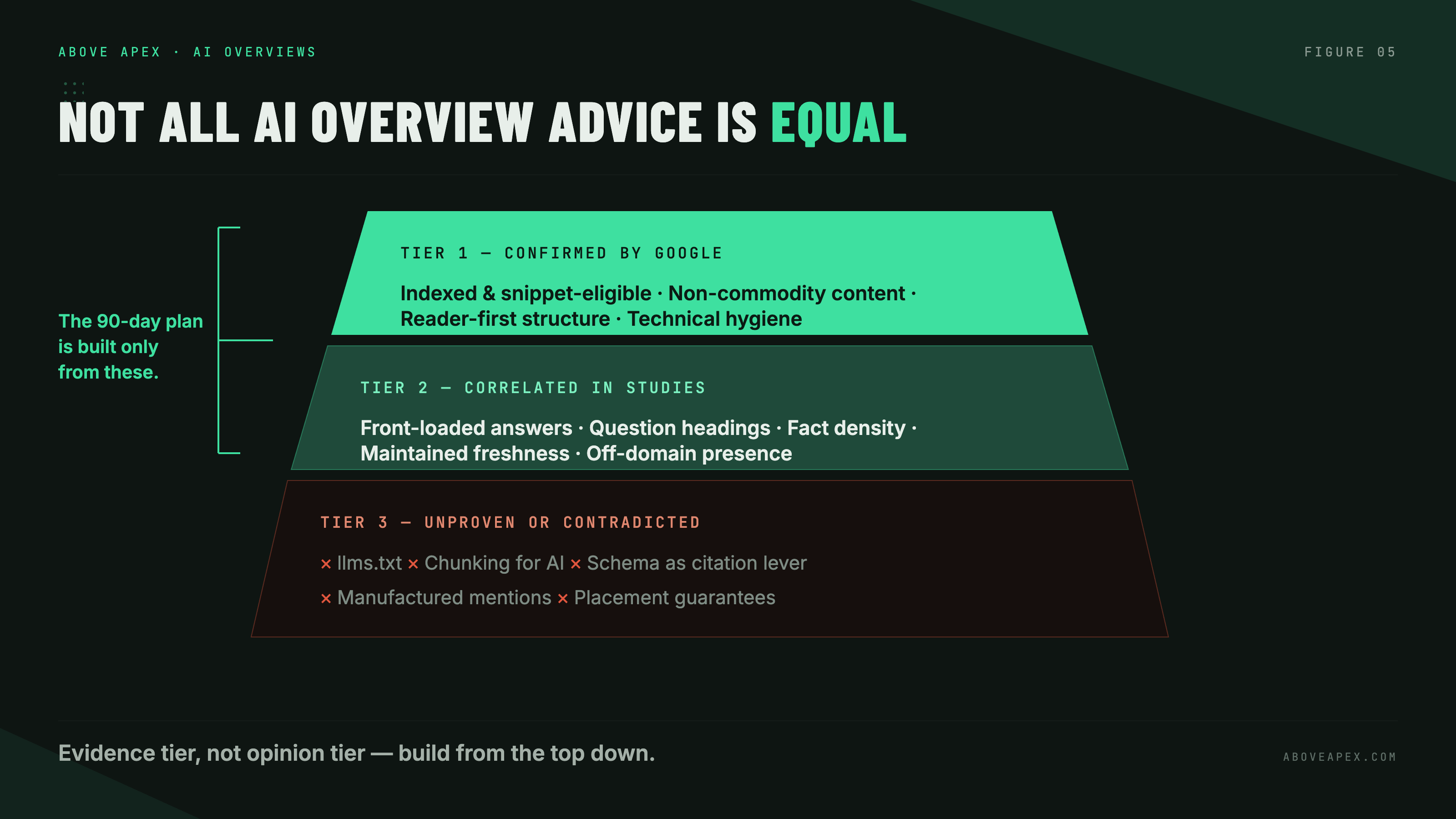
Tier 1 – Confirmed by Google
Everything here comes from Google’s official guide to optimizing for generative AI features. Do these first; they’re the only recommendations with a primary source behind them.
1. Be indexed, snippet-eligible, and enabled. A page must be indexed and eligible to appear with a snippet, and your site must be included in Search generative AI features in Search Console. Check this before touching anything else – accidental noindex tags and robots.txt blocks quietly disqualify more pages than any content problem.
2. Create non-commodity content. Google’s contrast is worth internalizing: a generic “7 Tips for First-Time Homebuyers” listicle built from common knowledge is commodity content that could originate from anyone; a first-hand account with a unique viewpoint goes beyond it. If your page restates what ten other pages already say, there is no reason for a model to cite yours. Original data, first-hand experience, and a defensible point of view are the raw material of citation.
3. Structure for readers, and don’t overthink the code. Google asks for content organized with paragraphs, sections, and headings that help people navigate – and explicitly says semantic HTML is helpful but perfection isn’t required. Clean structure is a courtesy to readers that machines happen to benefit from, not a machine-specific format.
4. Add high-quality images and video. Generative AI features can surface relevant media, which means more ways to appear than the text link alone.
5. Keep the technical foundation boring and solid. Crawlability, JavaScript SEO best practices, good page experience, minimal duplication. Nothing exotic – the same technical hygiene that governs regular Search governs this.
6. Don’t manufacture a page per fan-out query. Google warns that spinning up a page for every query variation primarily to manipulate rankings violates its scaled content abuse policy. Cover the fan-out within strong pages and a sensible cluster, not with a page farm.
Tier 2 – Correlated in third-party studies
These are observational findings, mostly from vendor research. Directionally useful, causally unproven. Weight them accordingly.
Front-load the answer. The one tactic every study and practitioner agrees on. Lead each section with the direct answer in the first sentence or two, then add depth. If the answer is buried three paragraphs down, the model finds an easier source.
Use question-based headings. AI Overviews co-occur with People Also Ask on 98.54% of SERPs (SE Ranking). Structuring headings around the questions people actually ask aligns your page with the retrieval patterns already in play.
Increase fact density. SE Ranking found AI Overview-cited articles cover 62% more facts than non-cited ones. Named sources, specific numbers, dates. Vague positioning gives a model nothing to extract; category-level superlatives don’t survive the filter.
Use lists, tables, and clean heading hierarchy – with a caveat. AirOps’ analysis of 12,000+ pages found list sections in 78.3% of ChatGPT-cited pages versus 26.8% of Google’s top organic results, with similar gaps for heading structure and schema presence. But note what that comparison actually is: two different sets of pages, not a controlled test. Cited pages skew toward docs, comparisons, and listicles – formats that are inherently list-heavy. The gap may measure page type as much as formatting. Our take: structure is cheap and helps readers regardless, so do it – just don’t expect formatting alone to earn citations for commodity content.
Target conversational, long-tail queries. Queries of 4+ words trigger AI Overviews in 60.85% of cases (SE Ranking). These map to specific questions, which map to extractable answers.
Update aged pages substantively. Per the freshness data above. A quarterly refresh cycle on your highest-value pages – new data, new examples, removed stale claims – beats publishing net-new pages on the same topics.
Build presence beyond your own domain. This is the lever most AI Overview guides mention in one paragraph and move past, and it’s the one with the most headroom. Research across AI search surfaces (AirOps, 21,000+ brands) found 85% of brand mentions in AI answers happen on third-party domains – and roughly 90% of third-party citations come from listicles, comparison pages, and review sites, with 80% of cited brands sitting in the top three positions on those pages. User-generated platforms carry real weight too: community content accounts for ~48% of AI citations, with Reddit alone near 22%.
That data comes from AI search broadly rather than Google Overviews specifically – but the direction is corroborated everywhere, including on the exact SERP this article targets, where a Reddit thread outranks eight professionally optimized guides. When a buyer asks any AI system “what’s the best [your category] software,” the answer is assembled largely from pages you don’t own. Getting into the top three of the listicles your buyers actually consult, earning editorial mentions on sites models already trust, and having a real presence in community conversations is GEO-focused off-page work – it’s what we do all day, and it’s why we track AI citations as a primary campaign KPI rather than a curiosity.
Tier 3 – Unproven or contradicted by Google
This tier exists because Google published a mythbusting list, and half the industry kept recommending the myths anyway.
| Commonly recommended | Google’s actual position | What to do |
|---|---|---|
| Create an llms.txt file | Google Search doesn’t use these files – they neither help nor harm | Skip for Google. Maintain one only if other systems you care about read it |
| “Chunk” content into small pieces for AI | No requirement to break content up; there’s no ideal page length | Structure for readers, full stop |
| Rewrite copy specifically for AI systems | Not needed – systems understand synonyms and meaning; you don’t need every phrasing variation | Write for your audience |
| Schema markup as a citation requirement | Structured data is not required for generative AI features; there’s no special markup to add | Implement schema for rich results in classic Search – a real benefit – not as an AI Overview lever |
| Build brand mentions at volume | Seeking inauthentic mentions isn’t as helpful as it might seem; ranking systems focus on quality while others block spam | Earn real coverage in real places. The distinction between earned and manufactured is the entire game – see below |
| Tools claiming internal Google metrics | No third-party tool has access to Google’s internal ranking or AI systems | Use tools for workflow; verify their advice against Google’s documentation |
The schema row deserves a beat, because it’s where this article disagrees with most of what ranks alongside it. Multiple popular guides present a catalog of schema types as essential AI Overview infrastructure. Google says plainly that it isn’t required and there’s no special markup. Both things can be true at once: schema earns rich results, clarifies entities, and costs almost nothing – so we implement it on every page, including this one. But recommending it as the mechanism for getting cited is presenting correlation as causation, and Google has already told you it isn’t the mechanism.
Same nuance on mentions. Google’s caution is about inauthentic mention-seeking – paid mention schemes, spam placements, manufactured buzz. Earned presence in editorially real places is a different thing entirely, and it’s precisely what the off-domain citation data rewards. The test is simple: would the mention exist if an editor, not an invoice, decided? As John Mueller put it about the acronym gold rush around AI optimization: the stronger the urgency and the push of new acronyms, the more likely someone’s just making spam and scamming. The fundamentals didn’t change. The surfaces did.
A 90-Day AI Overview Optimization Plan
Built only from Tier 1 and Tier 2. Sequenced, because most of the published advice is an unordered pile.
Days 1-30: Eligibility and baseline
- Confirm indexation and snippet eligibility on every target page; hunt down accidental noindex tags, robots.txt blocks, 4XX errors, and JS rendering failures
- Verify inclusion in Search generative AI features in Search Console
- Baseline the Search Console generative AI performance report
- List the 20-50 queries that matter commercially and check which currently trigger AI Overviews – and who’s cited in them
- Cross-reference against your rankings: the queries where you’re organic top 10 are your eligible set. Start there
Days 31-60: Content engineering
- Front-load answers on the eligible set – first two sentences of each section carry the extractable claim
- Convert headings to question form where the intent is question-shaped
- Add a definition block to each pillar page
- Raise fact density: named sources, numbers, dates; strip category-level superlatives
- Substantively update your aged high-value pages – new data, not new datestamps
- Map the query fan-out for each pillar topic and close the gaps within the cluster
- Add first-hand material: original data, expert quotes, real examples – the non-commodity layer Google keeps pointing at
Days 61-90: Off-domain and measurement
- Pull the “best [category]” listicles and comparison pages your buyers actually consult; audit whether you appear, and where – top three or effectively invisible
- Prioritize earning inclusion and position on those pages over further polishing your own comparison page
- Earn editorial mentions and expert-quote placements on high-authority sites in your category
- Show up authentically in the community conversations where your category gets discussed
- Establish a monthly (not weekly) review cadence and re-baseline
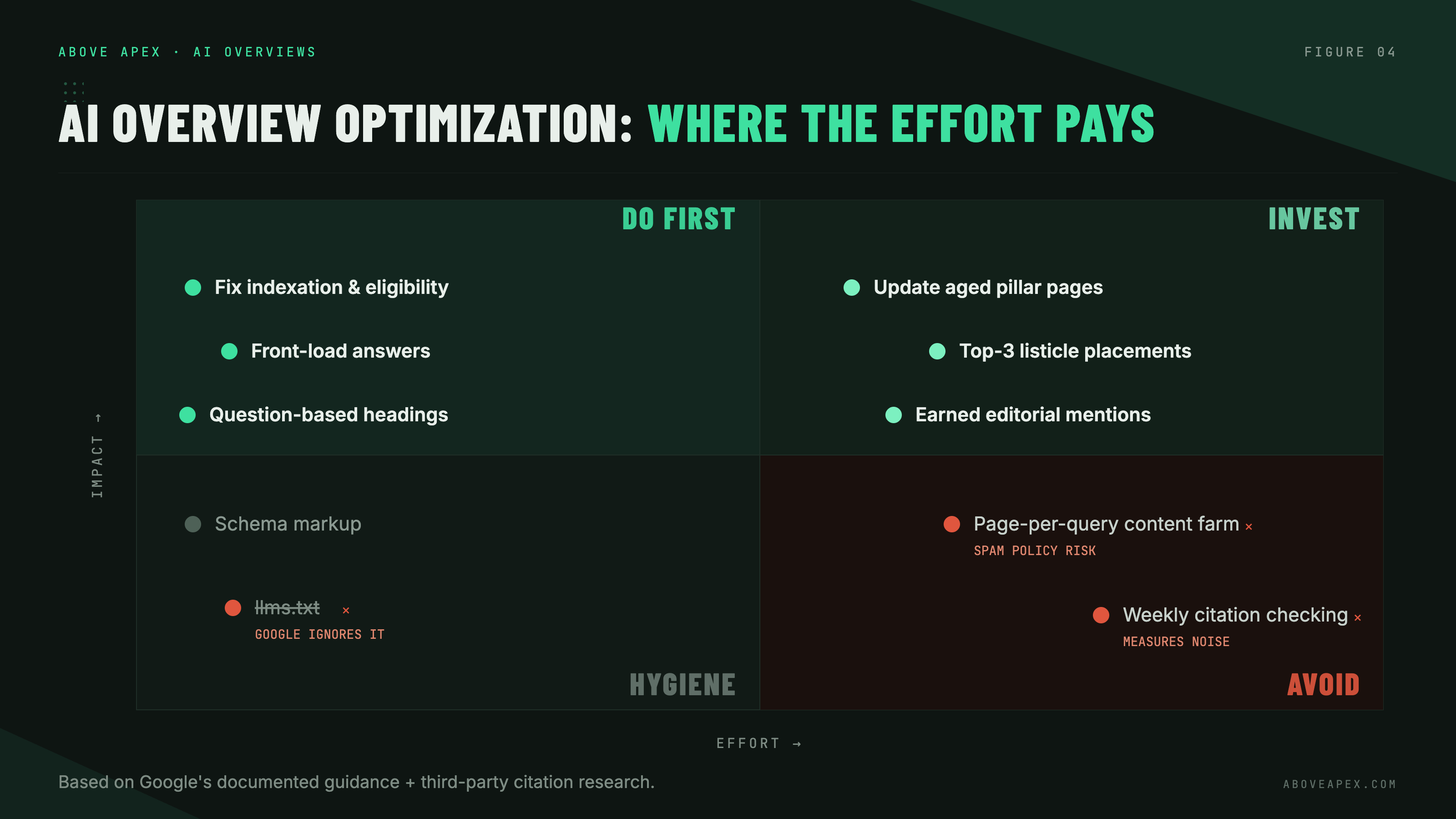
How to Measure AI Overview Visibility
The measurement advice circulating right now overpromises, so here’s the honest version.
Search Console is the official source – with a catch. The generative AI performance report shows how your content performs in generative AI features. But all click data – regular organic, SERP features, AI Overviews, AI Mode – arrives bundled in the performance report, and Google hasn’t announced plans to break it out. Anyone promising you a precise “AI Overview traffic” number is deriving it, not reading it.
Third-party trackers see the SERP, not the system. Tools that monitor AI Overview presence for your keywords (SE Ranking’s AIO research, Semrush’s SERP feature filters, Ahrefs’ Brand Radar, Profound) are genuinely useful for spotting where you’re cited and where competitors are. Just remember Google’s explicit warning: no third-party tool has access to its internal ranking or AI systems. They observe outputs. Treat their recommendations as hypotheses to check against the documentation.
Review monthly, not weekly. Here’s where we break with the standard advice. Given run-to-run volatility, a weekly single-sample citation check is mostly measuring noise. What works: sample your priority prompts multiple times per measurement window, review monthly, judge the trend over 90 days. Citation presence behaves like a portfolio, not a scoreboard.
When you’re cited but not getting clicks: this is now the normal case – remember Pew’s ~1% click rate on links inside Overviews – and it’s the question no guide answers. The answer is to change what you count. If the Overview is the impression, measure branded search volume, direct traffic, demo-form “how did you hear about us” answers, and assisted conversions. As commercial-intent Overviews grow, being in the shortlist matters more than the session. Which brings us to what that looks like in practice.
What This Looks Like in Practice: Three SaaS Campaigns
Everything above is sourced from Google and public research. This section is ours. We run off-page campaigns – links, listicle placements, expert quotes, and brand mentions – for B2B SaaS companies, and since AI citations became measurable we’ve tracked them as a primary KPI on every engagement. Three examples with real numbers:
Improvado: from near-zero to 693 AI citations
Improvado is a marketing analytics platform in one of the most crowded categories in SaaS. Our campaign centered on editorial links and brand mentions from sites the models already trust – Hootsuite, HubSpot, Zapier – alongside systematic listicle placement in the “best marketing analytics tools” ecosystem. The results on the AI side:
- 82 ChatGPT citations – all new
- 328 Gemini citations (+326)
- 246 Perplexity citations (+156)
- 37 Google AI Overview citations – all new
- ~20,000 additional organic monthly visits alongside the citation growth
Note the shape of that result: the same placements drove both the traffic and the citations. There was no separate “AI campaign” – the off-domain authority work fed both surfaces, which is exactly what the third-party data in Tier 2 predicts.
Ketch: winning the commercial-intent Overviews
Data privacy SaaS Ketch is the cleanest illustration of the intent-shift point. The campaign targeted their revenue pages – not blog posts – and the category terms buyers actually evaluate on:
- “data privacy software”: position 9 → 1
- “privacy compliance software”: position 9 → 1
- Weekly organic traffic: 3,635 → 5,360 (+47%)
- 105 Google AI Overview citations, plus 10 ChatGPT, 11 Perplexity, and 6 Gemini
The sequence matters: ranking on the commercial terms came first, the Overview citations followed. Entry ticket, then prize – the 92.36% pattern playing out on a single account.
Action1: authority placements feeding AI visibility
For endpoint management platform Action1, placements landed on HubSpot (DR 93), Nasdaq (DR 90), Hootsuite (DR 91), Visme (DR 86), and JotForm (DR 93). Downstream:
- 196 Google AI Overview citations
- 23 ChatGPT citations and 18 Gemini citations – all new
- +43,000 organic monthly visitors over the engagement
Petar Hristov, Head of Search & Content at Action1, summarized it better than we could: “Above Apex built high-quality, contextual backlinks from authoritative, relevant domains, significantly boosting our organic visibility and domain authority.”
One pattern across all three – and across clients like Synthesia, Photoroom, Teamflect, and Outbuild: we didn’t change what these companies published on their own sites. The AI citation growth came from where the brand appeared elsewhere. That’s the 85% figure from Tier 2, showing up in production data. Ani, Head of Content at Neptune AI, put it this way after a few months of working together: “We saw improvements in our search rankings within months, and we’re making visible progress on the AI search side as well, which has been our focus.”
More of these, with the full numbers, are in our case studies.
AI Overviews vs. AI Mode vs. ChatGPT and Perplexity
These get conflated constantly, and the tactics don’t transfer 1:1.
| Google AI Overviews | Google AI Mode | ChatGPT / Perplexity / Gemini | |
|---|---|---|---|
| What it is | AI summary at the top of a standard SERP | Fully conversational search experience, introduced 2025 | Assistant answers with web retrieval |
| Entry requirement | Indexed, snippet-eligible, and in practice ranking – 92% of Overviews cite a top-10 domain | Same index and eligibility; heavier fan-out | No Google ranking prerequisite; each system retrieves differently |
| What gets cited most | Pages already ranking; structured, front-loaded answers | Similar, across more sub-queries | Heavier weight on third-party sources: listicles, review sites, Reddit, docs |
| Tactics that converge | Originality, front-loaded answers, structure, maintained freshness, off-domain presence | ||
| Tactics that diverge | Classic SEO is the gate | Cluster depth matters more | Off-domain presence matters most; your own rankings matter least |
The convergence row is the strategy: the work that compounds across all four surfaces is non-commodity content on your site plus earned presence off it. The divergence row is the budget allocation: the more your buyers live in ChatGPT and Perplexity, the more the off-domain share of your effort should grow.
Tools for AI Overview Optimization
Short version, because the tool matters less than the workflow:
- Google Search Console – eligibility checks, indexation, and the generative AI performance report. The only first-party data that exists.
- AI Overview trackers (SE Ranking AIO Research, Semrush SERP-feature filters, Ahrefs Brand Radar) – which of your keywords trigger Overviews, who’s cited, and where you’re absent. We use Ahrefs’ AI citation dashboards in client reporting.
- Cross-platform citation monitors (Profound and similar) – brand presence across ChatGPT, Perplexity, Gemini, Copilot, and Grok.
- Keyword tools with word-count filters – for surfacing the 4+ word conversational queries that trigger Overviews 60.85% of the time.
And the standing caveat, from Google itself: no tool has access to its internal systems. If a tool’s recommendation contradicts the documentation, the documentation wins.
AI Overview Optimization FAQs
Is AI Overview optimization different from SEO?
Google’s answer: no – optimizing for generative AI search is optimizing for the search experience, and thus still SEO. In practice it’s SEO with a second scorecard: citation presence, measured differently from rankings, with more weight on off-domain authority.
Do I need schema markup to appear in AI Overviews?
No. Google states structured data is not required for generative AI features and there’s no special markup to add. Implement schema anyway – it earns rich results in classic Search – but don’t buy it as a citation mechanism.
Does llms.txt help with Google AI Overviews?
No. Google Search ignores llms.txt files entirely; creating one neither helps nor harms your Google visibility. Other AI systems may read it, so keep one if those matter to you.
How long does AI Overview optimization take to show results?
If you already rank top 10 for target queries, content and structure changes can show up in citations within weeks. If you don’t rank yet, you’re doing SEO first – realistically 60-90+ days before the citation layer even becomes available to you, consistent with what we see across client campaigns.
Can I opt out of AI Overviews?
Not specifically. There’s no AI-Overview-only opt-out; the blunt instruments (noindex, nosnippet, robots.txt) all reduce your regular Search visibility too.
How do I know if my content is being cited?
Manually check your priority queries (multiple times – single checks mislead), watch the Search Console generative AI performance report, and use a tracker for coverage at scale. Judge trends monthly, not weekly.
Will AI Overviews reduce my organic traffic?
On affected informational queries, expect meaningfully fewer clicks – Pew’s data shows traditional-result clicks dropping from 15% to 8% when an Overview is present. The offset: citation presence builds brand awareness pre-click, and the clicks that remain skew higher intent. Measure shortlist presence and branded demand, not just sessions.
Are AI Overview placement guarantees legitimate?
Be skeptical. Google states that meeting every requirement doesn’t guarantee crawling, indexing, or serving – and citation presence is volatile run to run. Nobody controls the output. What a competent partner can do is systematically build the inputs that correlate with citations: rankings, authority, and off-domain presence.
The Honest Summary
AI Overview optimization in 2026 is three moves. Keep your classic SEO sharp, because ranking is the entry ticket. Make your on-site content genuinely non-commodity, front-loaded, and maintained. And put real effort into the surface most guides ignore: the listicles, editorial mentions, and community conversations where 85% of AI-answer brand visibility actually gets decided.
The first two you can largely do in-house. The third is a relationships-and-outreach discipline that compounds slowly and is hard to fake – which is exactly why it’s defensible.
If you’re a B2B SaaS company and you want to see where your brand currently stands across AI Overviews, ChatGPT, Perplexity, and Gemini – and what it would take to change it get a free AI visibility audit. We’ll show you the citation data on your category and your fastest wins before you commit to anything.